The unit of customer intent has moved from the keyword to the prompt — a longer, more contextual, often multi-intent question typed to a model instead of a search box. The average ChatGPT prompt runs 23 words against roughly 3.4 words for a US Google query (Semrush, March 2025), and 65–85% of real prompts match no keyword at all in a 27-billion-term database (Semrush, March 2026). This article explains what prompt research is, how to collect prompts, how to map them to content, and why classic keyword research no longer covers how customers ask. Data reviewed as of .
What is prompt research, and how is a prompt different from a keyword?
Prompt research is the practice of collecting and analyzing the actual questions customers type into generative engines, then treating those prompts — not keywords — as the unit of intent you plan content around. A generative engine is a system that answers with a generated response instead of a list of links (ChatGPT, Perplexity, Google AI Overviews, Copilot). The prompt is what a customer asks it, in their own words.
The gap between a keyword and a prompt is measurable. The average ChatGPT prompt is 23 words long, reaching up to 2,712 words (Semrush, March 2025, from 80 million clickstream records), while the average US Google query sits at about 3.4 words (Semrush, 2025). More telling: 70% of prompts are unique, phrased in language rarely or never seen in classic search engines (Semrush, March 2025). A separate study of 8,500+ prompts across nine industries found the average behind-the-scenes query ran 5.48 words, with 77% of queries hitting five words or more, and a strong lean toward local intent (59%) and commerce (41%) (Nectiv, October 2025). A prompt is not a longer keyword — it is a different kind of object: contextual, conversational, and frequently carrying several intents at once.
Why is classic keyword research no longer enough for AI intent research?
Classic keyword research is insufficient because most real prompts have no keyword equivalent to research against. When Semrush tried to match prompts to its keyword database, 65–85% of prompts matched no keyword at all in a base of 27 billion terms — direct evidence that keyword tools do not cover the language of prompts (Semrush, March 2026, from over 1 billion clickstream lines). You cannot build a plan around search volumes for questions that never appear as keywords.
The ranking layer breaks the same way. Across 15,000 long-tail queries, only 12% of the links cited by ChatGPT, Gemini, and Copilot sat in Google’s top 10, and roughly 80% of cited pages did not rank anywhere in Google for the original query (Ahrefs, August 2025). Position — the whole currency of keyword research — is a weak predictor of what gets quoted in an answer. This is one of the clearest reasons AI visibility is not rebranded SEO; we unpack the wider strategic split in GEO vs SEO: what actually changes, and set the broader context in our complete guide to generative engine optimization.
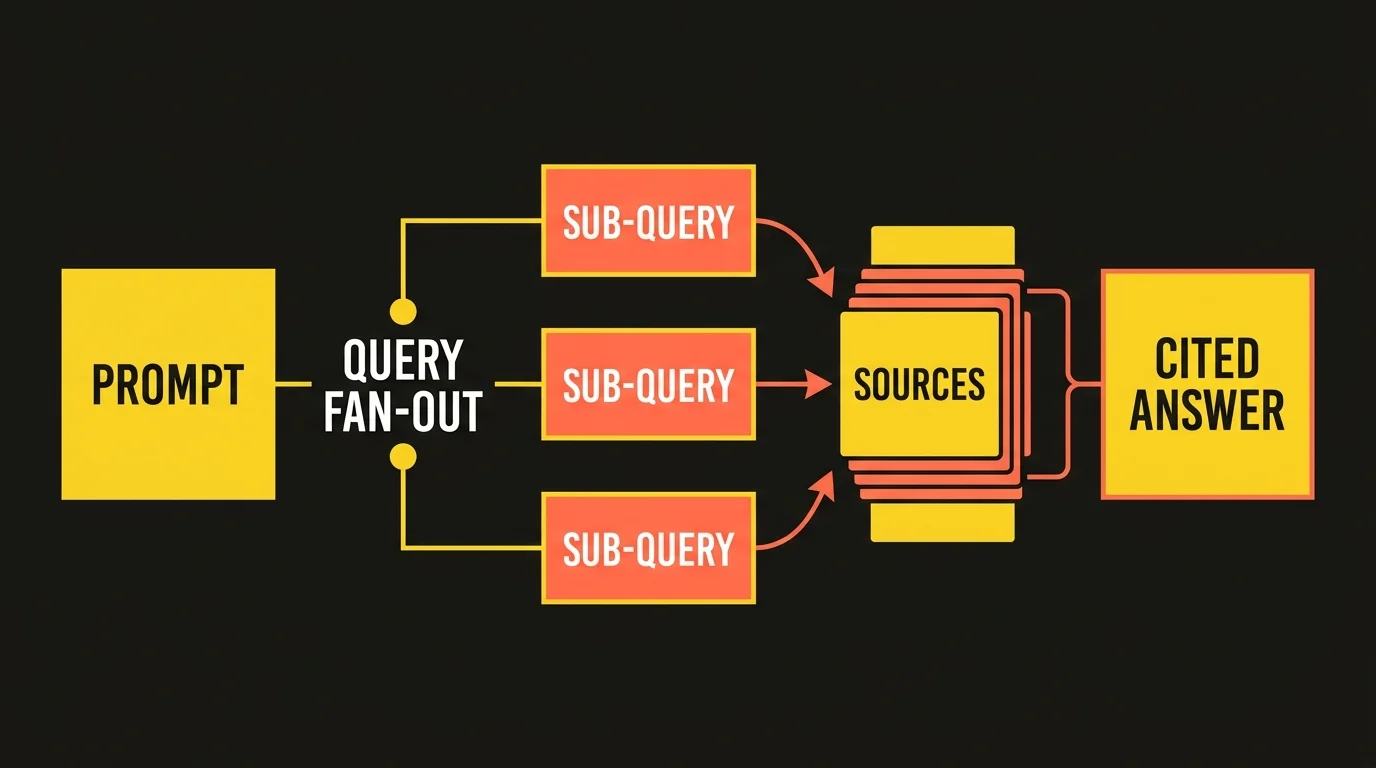
Why does one prompt become many queries (query fan-out)?
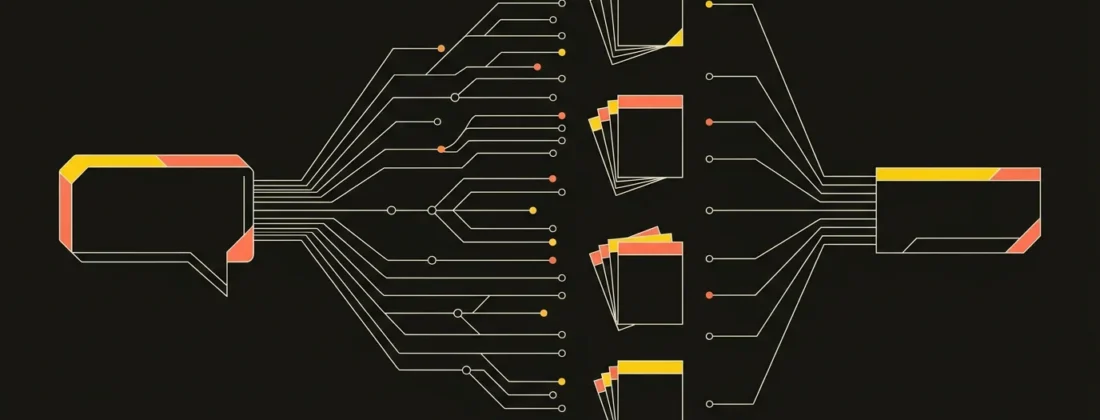
One prompt rarely stays one query — the engine expands it into several parallel searches, so the intent you need to cover is fragmented across sub-questions. Google confirms this officially: its AI Mode uses “query fan-out,” described as “breaking down your question into subtopics and issuing a multitude of queries simultaneously on your behalf” (Google, May 2025). One prompt goes in; many queries come out.
Google has been designing for this shift explicitly. At Google I/O in May 2024 it framed the change as: “Rather than breaking your question into multiple searches, you can ask your most complex questions, with all the nuances and caveats you have in mind, all in one go” (Google, May 2024). The behavior shows up in the data too: in the 8,500-prompt study, engines ran a search in 31% of prompts and averaged 2.17 queries per prompt when they did (Nectiv, October 2025). And fan-out is pulling citations away from the familiar first page: the share of AI Overviews citations drawn from Google’s top 10 fell from 76.1% in July 2025 to 37.9% by March 2026, meaning about 60% of AI Overviews citations now come from beyond the top 10 (Ahrefs, March 2026). Researching a single head keyword misses the sub-questions the engine actually asks.
How do you collect prompts (PAA, forums, sales calls, tools)?
You collect prompts where customers already ask in their own words — not by guessing, but by harvesting real questions from four sources. Each surfaces the long, contextual phrasing that keyword tools flatten out:
- People Also Ask — Google’s expandable question boxes are a growing, explicit feed of real user questions. PAA visibility in the US grew 34.7% between February 2024 and January 2025 (seoClarity, via Search Engine Land, 2025). Scrape the questions and their follow-ups; they read like prompts already.
- Forums and communities — Reddit, Quora, niche forums, and reviews are where customers ask messy, multi-intent questions publicly. This matters because AI answers are built largely from third-party sources: earned media accounts for roughly 84% of AI citations, not brands’ own content (Muck Rack, May 2026). The places engines read are the places your customers ask.
- Sales and support calls — the highest-fidelity prompt source you own. Transcribe calls and pull the exact wording of objections, comparisons, and “what about…” questions. These are prompts with buying intent attached.
- Prompt and clickstream tools — panel-based datasets (like the Semrush and Nectiv studies above) and AI-visibility trackers expose aggregate prompt patterns you cannot see from your own funnel alone.
The goal is a prompt library organized by intent and decision stage, not a keyword spreadsheet ranked by volume.
How do you map prompts to content?
You map each prompt to content by its intent, because intent — not the keyword or even the engine — is the strongest predictor of which content format gets cited. Analyzing 75,000 answers and 1,056,727 citations across ChatGPT, AI Mode, and Perplexity, Wix Studio’s AI Search Lab found intent to be the best predictor of cited format, ahead of industry or model (Wix Studio AI Search Lab, March 2026).
The format mix follows the intent. Across that dataset, listicles drew 21.9% of citations, articles 16.7%, and product pages 13.7% — but for commercial intent, listicles jumped to 40.86% (Wix Studio AI Search Lab, March 2026). So a comparison prompt maps to a structured comparison or list, not a narrative essay. Intent also changes whether your brand gets named at all: comparative content produced 2.4 times more brand mentions than informational content, in a study where 61.7% of AI citations were ghost citations — a URL cited without the brand named in the answer text (Semrush and Kevin Indig, June 2026).
| Prompt intent | Content to map to | Why |
|---|---|---|
| Commercial / comparison | Listicle, comparison table, “X vs Y” | Commercial intent drove 40.86% of citations to listicles; comparative content earns 2.4x more brand mentions |
| Informational / “what is” | Definition-led article, FAQ | Articles took 16.7% of citations, but informational formats name the brand least often |
| Transactional / “best for me” | Product page, structured spec | Product pages drew 13.7% of citations |
Source: Wix Studio AI Search Lab, March 2026; 1,056,727 citations.
Where should you start with prompt research?
Start not by writing new content but by mapping the prompts your customers actually ask and checking where you appear in the answers today. Collect real prompts from PAA, forums, and sales calls; cluster them by intent and decision stage; then check, per engine, which prompts already surface your brand, which your competitors own, and which are unclaimed. Only then does it make sense to plan formats — because the same intent that shapes the prompt also predicts the format an engine will cite.
That prompt-and-answer baseline is exactly what an AI visibility audit delivers before you commit budget to content; see our GEO services.
In the keyword era you researched what people typed. In the prompt era you research what people ask — longer, messier, and carrying several intents at once. The brands that win are not the ones with the biggest keyword lists, but the ones who mapped the real questions and answered them where the model looks.
FAQ
What is prompt research?
Prompt research is the practice of collecting and analyzing the real questions customers type into generative engines, then using those prompts — rather than keywords — as the unit of intent you plan content around. It matters because the average ChatGPT prompt runs 23 words versus about 3.4 words for a US Google query, and 65–85% of prompts match no keyword in a 27-billion-term database (Semrush, March 2026).
Why isn’t keyword research enough for AI intent research?
Because most prompts have no keyword equivalent and ranking barely predicts citations. In a 27-billion-term database, 65–85% of prompts matched no keyword at all (Semrush, March 2026), and across 15,000 long-tail queries only 12% of AI-cited links sat in Google’s top 10, with roughly 80% of cited pages not ranking anywhere for the query (Ahrefs, August 2025). Keyword volume and position simply do not map to what gets quoted.
How do I collect customer prompts?
Harvest real questions from four sources: People Also Ask (US visibility up 34.7% between February 2024 and January 2025, per seoClarity via Search Engine Land, 2025), forums and communities (earned media is roughly 84% of AI citations, per Muck Rack, May 2026), transcribed sales and support calls, and panel-based prompt or clickstream tools. Then cluster the prompts by intent and decision stage rather than by search volume.