GEO (generative engine optimization) is the practice of creating and optimizing content so that it gets cited and used in AI-generated answers — in ChatGPT, Perplexity, Google AI Overviews, and Microsoft Copilot. This guide is the parent page of the entire GEO category on the Vistrix Labs blog: it covers the definition, the mechanics of generative engines, the differences from SEO, a step-by-step implementation process, measurement, and the myths that collapse on contact with primary data. Every number in this article carries a named source and a date.
What is GEO (generative engine optimization)?
GEO (generative engine optimization) is the optimization of content for visibility in the answers of generative engines — systems that respond to a user with a generated answer instead of a list of links. The goal of GEO is not a ranking position. The goal is for a generative engine to use your page as a source: to cite it, link it, or name your brand in the answer text.
The term comes from a peer-reviewed academic paper: “GEO: Generative Engine Optimization” by Aggarwal, Murahari and co-authors, first published on arXiv in November 2023 and presented in its final version at KDD 2024. The authors built GEO-bench, a benchmark of 10,000 queries drawn from 9 sources across 25 topical domains. According to the paper’s abstract, content optimization can increase a source’s visibility in generative engine answers by up to 40% on the Position-Adjusted Word Count metric (Aggarwal et al., KDD 2024). That “up to 40%” figure needs context — an independent replication later challenged it, and this guide covers both sides in the myths section.
Two clarifications on the GEO meaning, because the acronym confuses people. First: GEO in this sense has nothing to do with geolocation or geo-targeted advertising — the letters simply collide. GEO stands for generative engine optimization, and on first mention the acronym should always be expanded. Second: part of the industry calls the same practice AEO (answer engine optimization), and some tools use “AI SEO” or “LLM SEO”. These labels describe one discipline. Across Vistrix Labs we use GEO as the umbrella term, consistent with the academic literature that defined it.
Why does generative engine optimization matter now?
GEO matters because AI-generated answers have become a mass-scale touchpoint between users and information — and classic search visibility does not cover that channel. The scale is measurable:
- ChatGPT has 900 million weekly active users and 50 million paying subscribers as of February 2026, per OpenAI’s official announcement (TechCrunch, 2026) — up from the 800 million weekly active users reported in October 2025.
- AI Overviews — the AI-generated summaries above Google’s search results — reach more than 2 billion users monthly across 200+ countries and territories and 40 languages; AI Mode had passed 100 million monthly active users in the US and India at the same point — as of July 2025, per Sundar Pichai’s remarks on Alphabet’s Q2 2025 earnings call (Alphabet, 2025).
The consequence for brands: a growing share of decision journeys starts and ends inside an AI answer, without a website visit. If a generative engine answers your customers’ questions without citing your content and without naming your brand, you are absent from a channel that classic traffic analytics cannot even see. That absence is the problem GEO exists to solve.
How do generative engines work?
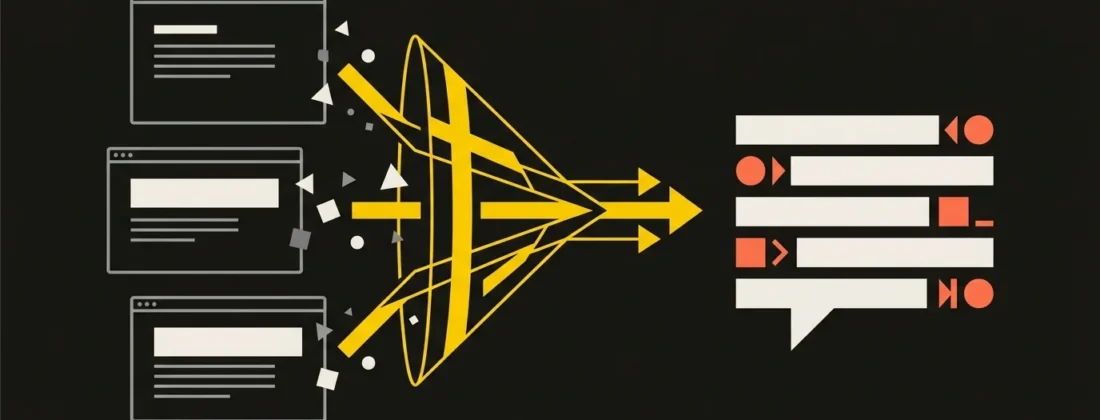
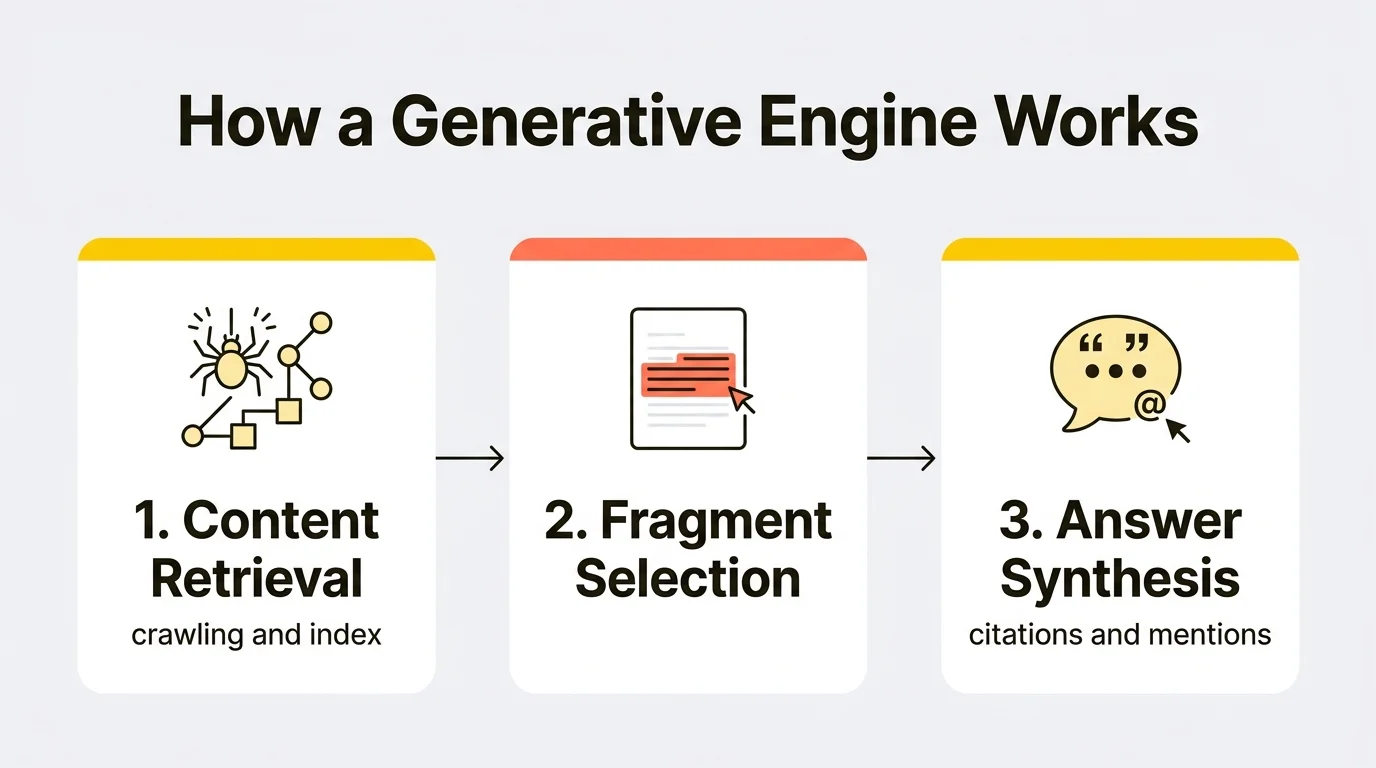
A generative engine combines a large language model (LLM) — an AI system that generates text — with search: it retrieves documents from an index, selects passages from them, and synthesizes an answer with citations. Basing the model’s answer on live search results rather than on training data alone is called grounding. The pipeline runs in four stages:
- Crawling — AI bots fetch content from websites (GPTBot, OAI-SearchBot, ClaudeBot, PerplexityBot, among others).
- Indexing and retrieval — for a user’s query, the engine pulls a set of matching documents from its index.
- Passage selection — specific fragments of those documents are placed into the model’s context window.
- Synthesis — the language model generates the answer and attaches citations: links or references pointing to pages as sources.
Three technical facts from official documentation and published research define the playing field.
Each engine has its own retrieval infrastructure. OpenAI separates its crawlers with independent robots.txt controls — among them GPTBot (model training), OAI-SearchBot (the ChatGPT search index), and ChatGPT-User (on-demand fetches triggered by a user) — so a site can block training and still remain visible in ChatGPT search; note that for user-triggered ChatGPT-User fetches, OpenAI’s documentation states that “robots.txt rules may not apply” (OpenAI crawler documentation, 2025). Microsoft Copilot retrieves web data exclusively through “Grounding with Bing Search” — only pages indexed by Bing can appear in Copilot answers, which makes Bing indexation (via Bing Webmaster Tools) a hard prerequisite for Copilot visibility (Microsoft Learn, accessed 2026).
AI crawlers do not execute JavaScript. The Vercel and MERJ study — which observed, among other things, 569 million GPTBot requests per month in its sample — states it plainly: none of the major AI crawlers render JavaScript. The bots download JS files but never execute them, so content rendered exclusively client-side is invisible to them (Vercel + MERJ, 2024).
Where a document lands in the model’s context heavily determines whether it gets cited. The independent C-SEO Bench benchmark (NeurIPS 2025) identified document position in the LLM context as the dominant factor, outweighing editorial tactics (Puerto et al., NeurIPS 2025). This finding returns in the myths section, because it caps what any on-page tactic can promise.
How is GEO different from SEO?
GEO differs from SEO in its goal (a citation in an answer instead of a click on a link), its unit of optimization (a quotable passage instead of a ranked page), and the signals that correlate with the outcome (brand mentions instead of backlinks). The two disciplines overlap technically — both require crawlable, indexable content — but results in one predict results in the other less and less.
The strongest evidence of the divergence: in an Ahrefs study of 15,000 long-tail queries, only 12% of the links cited by ChatGPT, Gemini, and Copilot appeared in Google’s top 10 for the same query, and roughly 80% of citations did not rank anywhere in Google for the original query (Ahrefs, 2025). Even inside Google’s own ecosystem, the share of AI Overviews citations coming from the top 10 fell from 76.1% in July 2025 to 37.9% in March 2026 — part of that drop reflects a change in measurement methodology, but around 60% of AI Overviews citations now come from outside the top 10, including 31.0% from pages outside the top 100 entirely (Ahrefs, 2026).
| Criterion | SEO | GEO |
|---|---|---|
| Goal | Ranking position and a click | Citation in an AI answer and a brand mention |
| Unit of optimization | Page / keyword | Passage a model can safely quote |
| Key authority signal | Backlinks | Brand mentions across independent sources |
| What the user sees | A list of links | A generated answer with sources |
| Measurement | Positions, organic traffic | AI share of voice, citations, brand mentions |
| Content structure | Keyword and intent coverage | Answer-first structure, quotable sentences, inline sources |
For the full comparison — including what carries over from the SEO toolkit and what has to be built from scratch — see our dedicated breakdown of GEO vs SEO: what changes in content optimization.
In SEO you compete for a position on a list of links. In GEO you compete for whether a language model can safely quote your sentence — the unit of optimization stops being the page and becomes the paragraph with a number, a date, and a source.
How do you implement GEO step by step?
The GEO process consists of six steps: measuring your starting point, removing technical blockers, restructuring content answer-first, enriching content with data and sources, building brand mentions beyond your own domain, and updating systematically. The order is deliberate — optimizing content that AI bots cannot see is wasted work.
Step 1: Measure your starting point
Start with an audit of your brand’s presence in AI answers: define a fixed set of 30–50 prompts your prospective customers actually ask, and run it through ChatGPT, Perplexity, Gemini, and Copilot (plus AI Overviews for queries that trigger them). Log whether the brand is mentioned, whether your URLs are cited, and who gets cited instead of you. This baseline is what you will measure AI share of voice against — the share of AI answers to a defined prompt set in which your brand appears.
Step 2: Remove technical blockers
There are three entry conditions, and they follow directly from how the engines retrieve content. First: critical content must be available in plain server-rendered HTML, because AI crawlers do not execute JavaScript (Vercel + MERJ, 2024). Second: robots.txt must allow the bots you care about — at minimum OAI-SearchBot, PerplexityBot, ClaudeBot, Google-Extended, and bingbot; OpenAI’s controls let you permit search visibility while opting out of model training (OpenAI, 2025). Third: verify indexation in Bing Webmaster Tools, because without the Bing index your site does not exist in Copilot (Microsoft, accessed 2026).
Step 3: Restructure content answer-first
Put the answer at the beginning — of the article and of every section. In Kevin Indig’s analysis of 1.2 million AI answers and 18,012 verified ChatGPT citations, 44.2% of citations came from the first 30% of the page’s content, 31.1% from the middle, and only 24.7% from the final third (Kevin Indig, Growth Memo, 2026). This is correlational data, not causal proof, but it is consistent with how passage selection works: the opening of a document reaches the model’s context more often than its tail. In practice: question-form headings, a complete answer in the first sentence of each section, lists and tables for enumerable facts, one claim per sentence.
Step 4: Enrich content with statistics, quotations, and sources
In the GEO-bench experiment, three editorial tactics produced the largest gains: adding expert quotations (Quotation Addition), adding statistics (Statistics Addition), and adding source references (Cite Sources) — relative improvements of 30–40% on Position-Adjusted Word Count and 15–30% on Subjective Impression, with effects varying strongly by topical domain (Aggarwal et al., KDD 2024). Honesty requires the other half of the picture: the independent C-SEO Bench replication did not confirm these effects on a citation-ranking metric — only 3 of 54 tested cases showed a statistically significant positive effect (~5.6%), and the statistics-addition method significantly worsened ranking in 19 of 24 settings (Puerto et al., NeurIPS 2025). We dissected both papers in the GEO paper (KDD 2024) vs its replication. The practical takeaway: numbers, quotations, and named sources raise the credibility and quotability of your content — treat them as a quality standard, never as a lever with a guaranteed percentage attached.
Step 5: Build brand mentions beyond your own site
Most of the sources generative engines lean on do not belong to brands. About 84% of citations in ChatGPT, Claude, and Gemini answers come from earned media — journalism and third-party industry sites — while paid content accounts for 0.3% of citations (Muck Rack, 2026; analysis of 25M+ links across 17 industries). In parallel, an Ahrefs correlation study of 75,000 brands found that branded web mentions correlate with brand visibility in AI answers roughly three times more strongly than backlinks: Spearman coefficients of 0.656–0.709 for mentions versus 0.218 for backlinks, with YouTube mentions as the strongest single correlate at ~0.737 (Ahrefs, 2025). YouTube’s weight shows up on Google’s side too: it accounts for 5.6% of all AI Overviews citations, making it the single most-cited domain (Ahrefs, 2026). These are correlations, not proof of causation — but the direction is unambiguous: digital PR, expert commentary, original data other people cite, and a YouTube presence do more for GEO than classic link building.
Step 6: Update content systematically
Chatbots favor fresher content: ChatGPT, Perplexity, Gemini, and Copilot cite pages that are on average 25.7% fresher than Google’s organic results (1,064 vs 1,432 days since publication; sample of 16.975 million cited URLs). The exception is AI Overviews, whose citations are roughly the same age as the SERP they sit on (Ahrefs, 2025). In practice: review pillar content quarterly, refresh the data, show a visible last-updated date — and treat this as editorial hygiene, not an algorithm trick.
How do you measure GEO results?
GEO results are measured with three separate KPIs: brand mentions in answer text, citations of your URLs as sources, and AI share of voice on a fixed prompt set — tracked monthly, per engine. Separating mentions from citations is not pedantry: according to the Semrush and Kevin Indig study, 61.7% of citations in AI answers are ghost citations — the page is linked as a source, but the brand never appears in the answer text; only 38.3% of citations come paired with a brand mention (Semrush + Kevin Indig, 2026).
The same study shows how differently the engines behave: Gemini names brands in 83.7% of their appearances but cites their pages in only 21.4%; ChatGPT is the mirror image — it cites in 87% of cases but names the brand in just 20.7% (Semrush + Kevin Indig, 2026; moderate sample, treat as an order of magnitude). Measuring one engine therefore tells you nothing about the others, and a one-off measurement tells you nothing about the trend. The minimum measurement setup:
- a fixed set of 30–50 customer prompts per service or product category,
- a monthly run through ChatGPT, Perplexity, Gemini, and Copilot (plus AI Overviews where relevant),
- a per-answer log: brand mentioned yes/no, URL cited yes/no, who was cited instead,
- a month-over-month trend report per engine.
If you want to see what this measurement looks like for your brand — from the prompt set to a report of the answer gaps you can claim — start with an AI visibility audit from Vistrix Labs: we measure where and how your brand appears in generative engine answers before we propose any action.
Which GEO tactics are myths?
The most common GEO myths concern “files for AI”, structured data, keyword density, and guaranteed uplifts — and each one loses to primary data or official documentation.
- Myth 1: “Just add an llms.txt file.” llms.txt is a proposed standard for a site content map aimed at AI systems — with no confirmed adoption. No major LLM provider (OpenAI, Anthropic, Google) uses it: of ~38,000 domains with a valid llms.txt file, 97% received zero requests for that file in May 2026, and Google’s John Mueller compared it to the keywords meta tag (Ahrefs, 2026; study of 137,000 domains).
- Myth 2: “You need special AI schema markup.” Google states it directly: “You don’t need to create new machine readable files, AI text files, or markup to appear in these features”, and no special schema.org structured data is required for AI features (Google Search Central, 2025). An Ahrefs quasi-experiment on 1,885 pages that added JSON-LD (against ~4,000 controls) found no positive causal effect: AI Overviews −4.6% (a small but significant drop), AI Mode +2.4% and ChatGPT +2.2% (both statistically insignificant) (Ahrefs, 2026). Structured data (schema.org) is technical hygiene, not a citation lever.
- Myth 3: “More keywords means more AI visibility.” The opposite is true: keyword stuffing worsened visibility in GEO-bench by about 9% versus baseline, and by about 10% on production Perplexity.ai (Aggarwal et al., KDD 2024).
- Myth 4: “GEO guarantees +40% visibility.” “Up to 40%” is the top result from one benchmark on one metric (Aggarwal et al., KDD 2024). The independent C-SEO Bench replication found a significant positive effect in just 3 of 54 cases and identified document position in the model’s context as the dominant factor (Puerto et al., NeurIPS 2025). Anyone promising a specific percentage uplift from GEO tactics is claiming more than the current state of evidence supports.
- Myth 5: “Whoever wins Google automatically wins AI.” Only 12% of chatbot citations overlap with Google’s top 10 (Ahrefs, 2025). Moreover, the original GEO experiments found a “democratization” effect: the Cite Sources tactic delivered +115.1% visibility for pages sitting fifth among the engine’s sources, against −30.3% for pages sitting first — measured on a simulated engine built from Google’s top 5 results (Aggarwal et al., KDD 2024). Inside a generated answer, visibility is a zero-sum game — and the biggest potential gains belong to brands outside the top of the rankings.
Where should you start with GEO?
Start with measurement, not optimization: without a baseline AI share of voice, you cannot tell whether anything you change has any effect. The sequence in this guide — audit, technical prerequisites, answer-first structure, data and sources in the content, mentions beyond your domain, systematic updates — orders the work from hard entry conditions to long-term levers. This article is the parent page of the GEO category on the Vistrix Labs blog: individual steps, studies, and comparisons get their own deep-dive posts, starting with GEO vs SEO: what changes and the GEO paper vs its replication. We will keep updating it as new data lands — because as the collision between GEO-bench (KDD 2024) and C-SEO Bench (NeurIPS 2025) shows, the state of knowledge about generative engines can change materially within a year.
FAQ: common questions about GEO
What does GEO stand for in marketing?
In marketing, GEO stands for generative engine optimization: the practice of creating and optimizing content so that generative engines — ChatGPT, Perplexity, Google AI Overviews, Copilot — cite it in their answers and mention the brand. The term was defined in a peer-reviewed paper at KDD 2024 (Aggarwal et al.). It is unrelated to geolocation or geo-targeting; AEO (answer engine optimization) is a near-synonym used by part of the industry.
Will GEO replace SEO?
No — GEO and SEO coexist, because generative engines are grounded in search indexes and AI Overviews live inside Google itself. What shifts is the weighting: since only 12% of chatbot citations come from Google’s top 10 (Ahrefs, 2025), a ranking position alone no longer guarantees presence in AI answers. The full picture is in our GEO vs SEO comparison.
Do I need llms.txt or special schema for GEO?
No. 97% of correctly published llms.txt files received zero bot requests in May 2026 (Ahrefs, 2026), and Google officially confirms that no special machine-readable files or markup are required to appear in its AI features (Google Search Central, 2025). The real priorities are content in plain HTML and AI bots allowed in robots.txt.
How do I check whether AI cites my website?
Run a fixed set of 30–50 customer prompts through ChatGPT, Perplexity, Gemini, and Copilot, and log two things separately: citations of your URLs and mentions of your brand in the answer text. They are different KPIs — 61.7% of AI citations are ghost citations, where the link appears but the brand is never named (Semrush + Kevin Indig, 2026). Repeat the measurement monthly, per engine.