
TL;DR: The Princeton GEO paper (Aggarwal et al., KDD 2024) reported up to 40% higher visibility in AI answers from tactics like adding quotations and statistics — measured on a simulated engine, with the authors’ own metrics. The independent C-SEO Bench replication (NeurIPS 2025) confirmed almost none of it: only 3 of 54 tested cases showed a significant positive effect, and none involved the original GEO methods.
What did the Princeton GEO paper actually claim?
The paper that coined GEO (generative engine optimization) — creating and optimizing content so that it gets cited and used in AI-generated answers — claims in its abstract that “GEO can boost visibility by up to 40% in generative engine responses” (Aggarwal et al., arXiv:2311.09735). The study by Aggarwal, Murahari and co-authors first appeared on arXiv on 16 November 2023 and was accepted at KDD 2024, with v3 published on 28 June 2024 (Aggarwal et al., 2024). Because of the lead authors’ Princeton affiliation, practitioners call it “the Princeton GEO paper” — though the team also spanned other institutions.
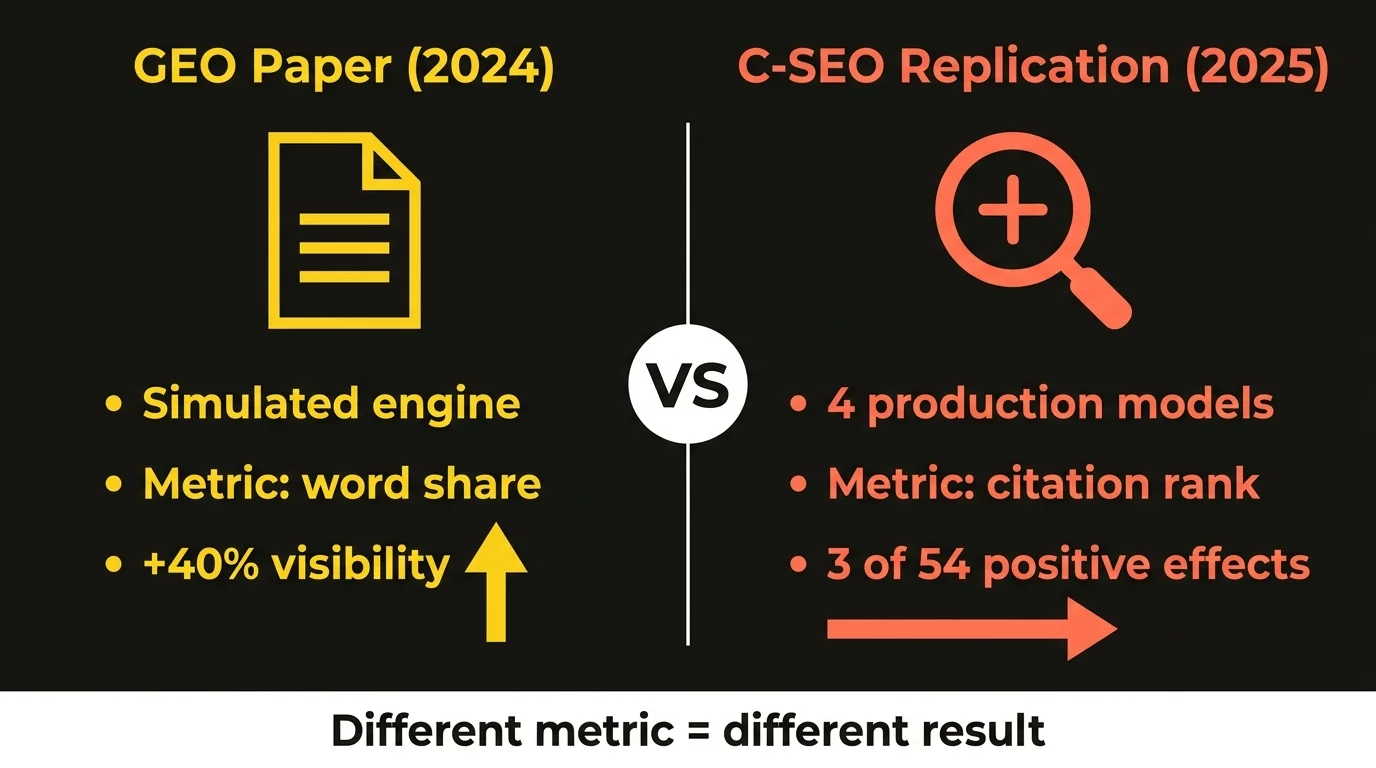
Three qualifiers around that headline number matter more than the number itself. First, “up to 40%” is a best-case figure for the best tactic on one of two custom metrics — not an average effect. Second, the experiments ran on a simulated generative engine, not on production AI Overviews or ChatGPT search. Third, as of July 2026, the only independent large-scale replication has not confirmed the effect on citation rankings. For broader context, see our generative engine optimization guide; this article covers only the evidence.
How was GEO-bench built — and what exactly did it measure?
GEO-bench, the paper’s benchmark, contains 10,000 queries split 8K/1K/1K into train, validation and test sets, drawn from 9 source datasets (including MS MARCO, Natural Questions, ELI5 and Perplexity.ai Discover) across 25 topical domains, with roughly 80% informational intent (Aggarwal et al., 2024, GEO-bench section). The generative engine itself was simulated: for each query, the top 5 Google results were fed to gpt-3.5-turbo, which generated 5 responses at temperature 0.7 (Aggarwal et al., 2024, experimental setup). A controlled proxy — not a production system.
“Visibility” was defined by two metrics the authors designed themselves (Aggarwal et al., 2024, metrics section):
- Position-Adjusted Word Count (PAWC) — the share of words in the generated answer attributed to a given source, weighted by how early in the answer the citation appears.
- Subjective Impression — an LLM-based rating of how prominently the source features in the answer.
Neither metric equals citation rate in a production generative engine — a system that answers with a generated response instead of a list of links. A source can gain word share inside an answer without becoming any more likely to be cited at all. That distinction is the hinge of the replication debate.
Which tactics worked in the GEO paper, with exact numbers?
Adding quotations was the strongest tactic on both metrics on the GEO-bench test set, and keyword stuffing actively hurt. The full test-set results (Aggarwal et al., 2024, Table 1):
| Tactic | PAWC (baseline 19.5) | Subjective Impression (baseline 19.3) |
|---|---|---|
| Quotation Addition | 27.8 | 24.7 |
| Statistics Addition | 25.9 | 23.7 |
| Fluency Optimization | 25.1 | 21.9 |
| Cite Sources | 24.9 | 21.9 |
| Technical Terms | 23.1 | 21.4 |
| Easy-to-Understand | 22.2 | 20.5 |
| Authoritative | 21.8 | 22.9 |
| Unique Words | 20.7 | 20.4 |
| Keyword Stuffing | 17.8 | — |
In relative terms, Quotation Addition means roughly +43% over the PAWC baseline, Statistics Addition roughly +33%, and Cite Sources roughly +28% (Aggarwal et al., 2024) — this is where the marketed “30–40%” range comes from. The tactic ranking shifts with the metric — Authoritative sits seventh on PAWC but third on Subjective Impression — so any single leaderboard deserves caution.
Three further findings deserve attention:
- Keyword stuffing backfired: 17.8 vs. the 19.5 PAWC baseline (about −9%) on the simulated engine, and 21.9 vs. 24.1 (also about −9%) on production Perplexity.ai (Aggarwal et al., 2024, Tables 1 and 5).
- GEO helped low-ranking pages most: Cite Sources produced +115.1% visibility for the page at source position 5 — and −30.3% for the page at position 1 (Aggarwal et al., 2024, Table 2, section 5.2). The authors framed this as democratization; it is equally a zero-sum reshuffle inside one answer — the lower-ranked page’s gain is the leader’s loss.
- The Perplexity check was in-house, not independent: on production Perplexity.ai, Quotation Addition scored 29.1 vs. a 24.1 PAWC baseline (about +21%) and Statistics Addition 33.9 vs. 24.7 on Subjective Impression (about +37%) (Aggarwal et al., 2024, Table 5). This was the authors’ own experiment on a 2023/24 snapshot of one engine — supporting evidence, not replication.
What did C-SEO Bench fail to confirm?
C-SEO Bench, an independent benchmark by Puerto et al. (arXiv:2506.11097, accepted at NeurIPS 2025 Datasets & Benchmarks), found a statistically significant positive effect in only 3 of 54 tested cases (method × domain × model) — and none of those three involved methods from the GEO paper. The only winners were two new methods the C-SEO Bench authors introduced themselves: LLM Guidance (+0.36 citation-ranking positions in Retail, +0.24 in Video Games) and Content Improvement (+0.18 in Retail) — all gains below half a position (Puerto et al., 2025, main results).
The replication was substantial: over 1,900 queries and around 16,300 documents across 6 domains (Retail, Video Games, Books, Web, News, Debate), testing 10 methods — 8 from the GEO paper plus the 2 new ones — on 4 models: gpt-4o-mini, Claude 3.5 Haiku, o3 and o4-mini (Puerto et al., 2025). Three results stand out:
- Statistics Addition flipped sign. One of the GEO paper’s best tactics decreased citation rankings in 19 of 24 evaluated settings. A separate model-level finding: on Claude 3.5 Haiku in product recommendation, 26 of 30 cases — across all 10 methods and 3 domains — showed a significantly negative effect (Puerto et al., 2025, per-method results).
- Position beat content edits. The authors conclude that “traditional SEO strategies… are significantly more effective”, and that placing a document first in the LLM’s context yields “far greater citation ranking gains than any C-SEO method” (Puerto et al., 2025, conclusions).
- Gains shrink under adoption. As more competitors within the same answer apply the same tactics, the benefit erodes — the authors describe the game as “congested and zero-sum” (Puerto et al., 2025).
The paper’s headline conclusion is blunt: “most current C-SEO methods are not only largely ineffective but also frequently have a negative impact on document ranking” (Puerto et al., 2025, abstract).
Why do the two studies disagree?
The single largest explanation is that the two papers measure different things under the same word, “visibility”. The GEO paper measures word share attributed to a source inside the answer (PAWC); C-SEO Bench measures whether the modified document gets cited earlier — “an effective method should lead the LLM to cite the modified document earlier than it cited the original document” (Puerto et al., 2025, metric definition). This metric difference partially explains the divergent results. Engine and era differences compound it: a 2023 simulation built on gpt-3.5-turbo versus 2024–2025 production models, including reasoning models.
Newer work has not restored the simple “+40%” story either. E-GEO (arXiv:2511.20867, preprint, November 2025), an e-commerce testbed with 7,000+ queries and 15 heuristics, finds that iterative, per-query optimization beats the GEO paper’s static heuristics — and criticizes the paper’s impression metric as not translating directly into commercial value. GEO-16 (arXiv:2509.10762, preprint, September 2025), an observational study of 1,702 citations across 3 generative engines (70 prompts, 1,100 URLs), found metadata and freshness, semantic HTML and structured data to be the strongest correlates of being cited — correlations on English B2B SaaS pages, not causal evidence. Generative engine optimization research is moving from universal claims toward conditional, engine-specific findings.
When a vendor quotes “+40% visibility from GEO” as an established fact, they are quoting one metric, from one simulated engine, from one 2023 experiment — whose tactics failed the only independent replication to date. The research supports testing these tactics. It does not support guaranteeing their results.
What does this mean for your content strategy?
Treat GEO tactics as hypotheses to test on your own queries — and keep investing in whatever gets your pages retrieved in the first place. As of July 2026, the research supports this playbook:
- Do not buy promised percentages. The “30–40% uplift” comes from a single study, on a specific metric, on a simulated engine; the independent C-SEO Bench did not confirm those effects on citation rankings (Aggarwal et al., 2024 vs. Puerto et al., 2025).
- Prioritize retrieval position. C-SEO Bench found classic SEO that improves a document’s position in the LLM’s context “significantly more effective” than any content-edit tactic (Puerto et al., 2025). GEO extends SEO rather than replacing it — see our breakdown of what actually changes between GEO and SEO.
- Never keyword-stuff. The one directional finding both papers agree on: roughly −9% on the GEO paper’s own tests, on both the simulated engine and Perplexity.ai (Aggarwal et al., 2024).
- Make quality edits for quality reasons. Sourced statistics, quotations and clear writing make content more trustworthy and easier to extract. Do them because they improve the page — then measure the citation effect per engine instead of assuming one.
- Measure, don’t extrapolate. Effects varied by domain, model and metric in every study cited here. The number that matters is your own AI share of voice — the share of AI answers to a defined prompt set in which your brand appears — tracked per engine, over time.
An AI visibility audit delivers exactly that measurement: where your brand appears in generative engine answers today, before you spend on tactics with mixed evidence — see how we audit brand visibility in AI answers.
FAQ
Did the Princeton GEO paper really show a 40% visibility increase?
Partly. The abstract says “up to 40%” — a best-case figure on the authors’ own Position-Adjusted Word Count metric, measured on a simulated engine (top-5 Google results answered by gpt-3.5-turbo), not on production systems (Aggarwal et al., 2024). The best single tactic, Quotation Addition, scored 27.8 vs. a 19.5 baseline on the test set.
Has the GEO paper been independently replicated?
One independent large-scale replication exists: C-SEO Bench (Puerto et al., NeurIPS 2025 Datasets & Benchmarks). On a citation-ranking metric, only 3 of 54 tested cases showed a significant positive effect — none from the GEO paper’s methods. Statistics Addition, a top GEO tactic, decreased rankings in 19 of 24 settings.
Are GEO tactics worthless, then?
No — the evidence is mixed, not null. The tactics raised word-share visibility under the GEO paper’s metric, and edits like sourced statistics improve content quality regardless. But C-SEO Bench shows a document’s position in the LLM’s context matters far more than content edits (Puerto et al., 2025), so SEO foundations come first.