A ghost citation is an AI answer that uses your page as a source but never says your brand’s name — and it is now the majority case, not the exception. In a study of 3,981 domain citations across four leading generative engines, 61.7% were ghost citations: a linked source with no brand mention anywhere in the answer text (Semrush and Kevin Indig, June 2026). This article defines the term, separates brand mentions from citations, and explains what that split means for anyone measuring AI visibility. Data reviewed as of .
What is a ghost citation?
A ghost citation is a URL cited as a source in an AI answer without the brand being named in the answer text. The generative engine — a system that answers with a generated response instead of a list of links (ChatGPT, Perplexity, Google AI Overviews, Copilot) — uses your page as a reference or footnote, but the reader of the answer never sees who published it. The page does the work; the brand gets no credit in the text a human actually reads.
The scale of the effect is the headline. Across 3,981 domain occurrences drawn from 115 prompts, 14 countries, and four leading AI engines, 61.7% of all citations were ghost citations, and only 38.3% coincided with a brand mention in the answer (Semrush AI Visibility Toolkit and Kevin Indig, June 2026). The sample is moderate, so treat these as orders of magnitude rather than precise constants — but the direction is unambiguous: being cited by a generative engine is, most of the time, invisible to the person reading the answer. If you are new to how generative engines select and credit sources, our complete guide to generative engine optimization sets the context this article builds on.
Brand mention vs citation in AI: why they are not the same thing
A citation and a brand mention are two distinct, largely non-overlapping events, and conflating them is the single most common measurement error in GEO. A citation is a link or reference to a page as a source inside a generated answer; a brand mention is the brand name appearing in the answer text, regardless of whether the page is linked. One can happen without the other, and usually does.
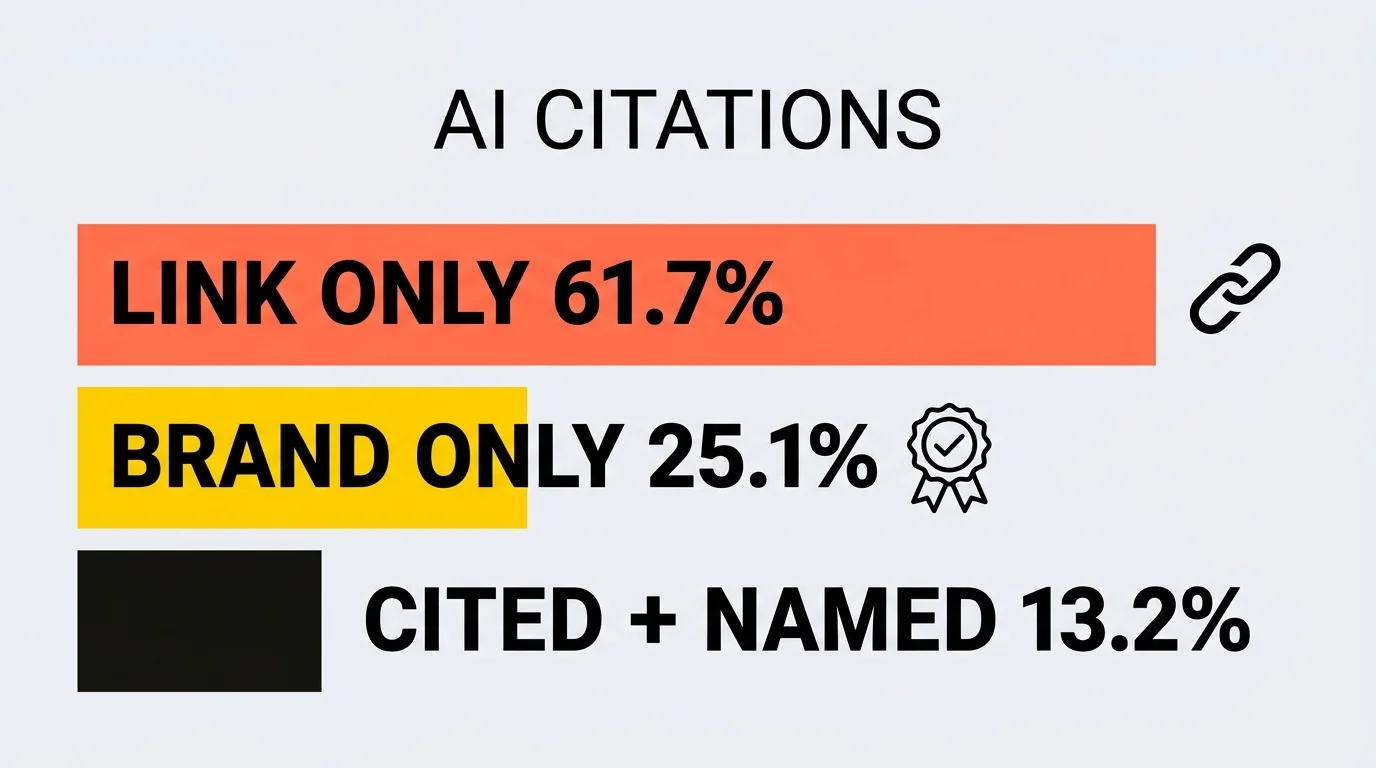
The Semrush data breaks the 3,981 occurrences into three buckets that make the gap concrete: only 13.2% were both cited and mentioned, 61.7% were a link with no brand name, and 25.1% were a brand name with no link at all (Semrush and Kevin Indig, June 2026). Read that again: the overlap — the case most dashboards assume is normal, where your page is linked and your brand is named together — is the smallest of the three groups. A quarter of the time the brand is named while some other page gets the link. This is why “we got cited” and “we got mentioned” are different claims that need different evidence.
| Outcome | Share of occurrences | What the reader sees |
|---|---|---|
| Cited and mentioned | 13.2% | Your page is linked and your brand is named |
| Ghost citation (link only) | 61.7% | Your page is linked; your brand is invisible |
| Mention only (no link) | 25.1% | Your brand is named; no link to your page |
Source: Semrush and Kevin Indig, June 2026; 3,981 domain occurrences.
Why ChatGPT and Gemini produce opposite problems
The ghost citation problem has two mirror-image shapes, and which one hits you depends on the engine. ChatGPT cites generously but names brands rarely; Gemini names brands generously but cites rarely. A strategy tuned for one leaves you invisible in the other.
ChatGPT cited a source in 87% of cases but named the brand in only 20.7% of them — a textbook ghost citation profile, where the link is there but the brand is stripped out of the prose (Semrush and Kevin Indig, June 2026). Gemini is the inverse: it put the brand name in the answer text 83.7% of the time but cited the page as a source in only 21.4% of cases (Semrush and Kevin Indig, June 2026). The practical consequence: a URL-only tracker overstates your presence in ChatGPT and understates it in Gemini, while a mention-only tracker does the exact opposite. Neither number, alone, describes where your brand stands.
Which queries and markets generate the most ghost citations?
Ghost citations cluster around informational queries and thin out on comparative ones, so the type of question your audience asks changes how visible your brand can be. On informational prompts, engines cited a source 89.3% of the time but named a brand in just 18% of answers — the purest ghost citation pattern in the dataset (Semrush and Kevin Indig, June 2026).
Comparative and commercial content behaves very differently. Comparative queries produced a 43.3% brand mention rate — 2.4 times higher than informational ones — because “X vs Y” answers structurally require naming the things being compared (Semrush and Kevin Indig, June 2026). Commercial queries showed an 84.4% citation rate against a 35.6% mention rate, and how-to content reached a 42.8% mention rate (Semrush and Kevin Indig, June 2026). The lesson is not to abandon informational content — it is the entry point for most AI answers — but to know that it is the format least likely to put your name in front of a reader, and to pair it with comparative and commercial content that does.
Geography adds another layer of variance. Brand mention rates ranged from 18% to 50% across markets: India and Sweden sat near 50%, while Italy, Brazil, and the Netherlands landed in the 18–22% band (Semrush and Kevin Indig, June 2026). If you operate in several countries, a single global “mention rate” hides a spread wide enough to lead you to the wrong conclusion in half your markets.
Why ghost citations break how you measure AI visibility
Because roughly 6 in 10 citations never name the brand, a single “AI visibility” figure is close to meaningless — you have to track mentions and citations as separate KPIs, and per engine. Collapsing them into one metric is not a simplification; it is a measurement error baked into your reporting.
This is exactly why we split AI visibility into three separate KPIs rather than one: (a) brand mentions in the answer text, (b) citations of your URLs as a source, and (c) the positions competing brands hold on the same prompts (Semrush and Kevin Indig, June 2026). Each answers a different question. Mentions tell you whether readers hear your name; citations tell you whether your pages are feeding the answer; competitor tracking tells you who is winning the prompts you both want. A dashboard that reports only one of the three will confidently mislead you — and, given the 61.7% ghost citation rate, it will most often flatter a citation count that no reader ever sees as brand awareness. The context for how large this data program is: the Ghost Citations study sits inside Semrush’s 2026 AI Visibility Index, which analyzes 126 million AI search prompts (Semrush, 2026).
What ghost citations mean for GEO strategy
The strategic conclusion is that both the URL and the brand name have to be strong, because the two travel through AI answers on separate tracks and you cannot predict which track a given engine or query will use. Optimizing only your pages leaves you cited-but-nameless in ChatGPT; building only brand awareness leaves you named-but-unsourced in Gemini. You need both to be resilient across engines.
Two independent datasets show why the brand name itself is load-bearing. Analyzing 75,000 brands, Ahrefs found that branded web mentions correlated with AI visibility at 0.656–0.709, versus 0.266–0.326 for Domain Rating and a much weaker correlation for backlinks — mentions correlated more than twice as strongly as these classic link metrics (Ahrefs, December 2025). That is a correlation, not proof of causation, and it should be read as such — but it aligns with the ghost citation finding that being named is a distinct, valuable outcome that links alone do not buy. On the URL side, Muck Rack’s analysis of 25 million-plus links found that 84% of AI citations came from earned media rather than brands’ own content (holding at 82–89% across three editions), while paid content accounted for just 0.3% (Muck Rack, May 2026). In other words, the pages engines cite are largely third-party coverage — so both a citable page and an unmistakable brand name have to exist out in the corpus, not just on your own domain.
If you want a baseline of where your brand actually stands across both KPIs before deciding what to build, that split measurement is precisely what an AI visibility audit delivers; see our GEO services. And because the ghost citation split is one of the clearest reasons AI visibility is not just rebranded SEO, we unpack the wider strategic differences in GEO vs SEO: what actually changes.
A citation your reader never sees is not brand visibility — it is your content working for an answer that forgets your name. In generative engines, being sourced and being named are two different wins, and you have to earn them separately.
FAQ
What is a ghost citation?
A ghost citation is when a generative engine uses your page as a source — linking or referencing it — but never names your brand in the answer text the reader sees. In a study of 3,981 AI citations, 61.7% were ghost citations, meaning the link was present but the brand was absent from the answer (Semrush and Kevin Indig, June 2026).
What is the difference between a brand mention and a citation in AI?
A citation is a link or reference to your page as a source inside an AI answer; a brand mention is your brand name appearing in the answer text, with or without a link. They are largely separate events: across 3,981 occurrences, only 13.2% were both cited and mentioned, 61.7% were a link with no brand name, and 25.1% were a brand name with no link (Semrush and Kevin Indig, June 2026). They must be measured as separate KPIs.
Which AI engines produce the most ghost citations?
ChatGPT has the strongest ghost citation profile: it cited a source in 87% of cases but named the brand in only 20.7% (Semrush and Kevin Indig, June 2026). Gemini is the reverse — it named brands 83.7% of the time but cited the source page only 21.4% of the time, so it has a “mention without citation” problem instead. Any visibility tracker therefore has to report both metrics per engine, because a single number describes neither.