You cannot see your brand’s AI visibility in Google Analytics, and you cannot infer it from rank tracking. Measuring it requires its own method: a fixed prompt set, separate KPIs for brand mentions and citations, measurement per engine, and enough repeated runs to average out the randomness of individual answers. This guide covers each step — how to build the prompt set, what to count, how often to run it, and when a spreadsheet stops being enough and dedicated AI visibility tools start making sense. It is the measurement layer of GEO (generative engine optimization) — creating and optimizing content so that it gets cited and used in AI-generated answers.
Why does brand visibility in AI answers need its own measurement?
Because the two systems marketers already use — web analytics and rank tracking — both miss it. AI answers replace clicks: when a Google search returned an AI summary, users clicked a traditional result in 8% of visits versus 15% without one, and clicked a source link inside the summary in just 1% of visits (Pew Research Center, 2025; 68,879 searches by 900 US adults, March 2025). A brand can be recommended by name in thousands of answers and register nothing in its traffic reports.
Rank tracking does not substitute either. Across 15,000 long-tail queries, only 12% of links cited by ChatGPT, Gemini and Copilot ranked in Google’s top 10 for the same query, and about 80% of cited pages ranked nowhere in Google for it (Ahrefs, 2025). Even inside Google’s own ecosystem the link is weakening: the share of AI Overviews citations coming from the organic top 10 fell from 76.1% in July 2025 to 37.9% in March 2026, with 31% of citations coming from beyond the top 100 — part of the drop reflects a methodology change between the two Ahrefs editions, but the direction stands (Ahrefs, 2026). Why the two disciplines diverge is the subject of GEO vs SEO — what actually changes.
The audience being measured is not a niche. ChatGPT reached 800 million weekly active users, per Sam Altman’s announcement at OpenAI DevDay in October 2025 (TechCrunch, 2025). The practice has followed: 78.4% of digital PR professionals now track their brand’s AI visibility, though only about 40% report a repeatable method for earning AI citations (BuzzStream State of Digital PR 2026; 150+ practitioners surveyed).
How do you build a prompt set for AI brand monitoring?
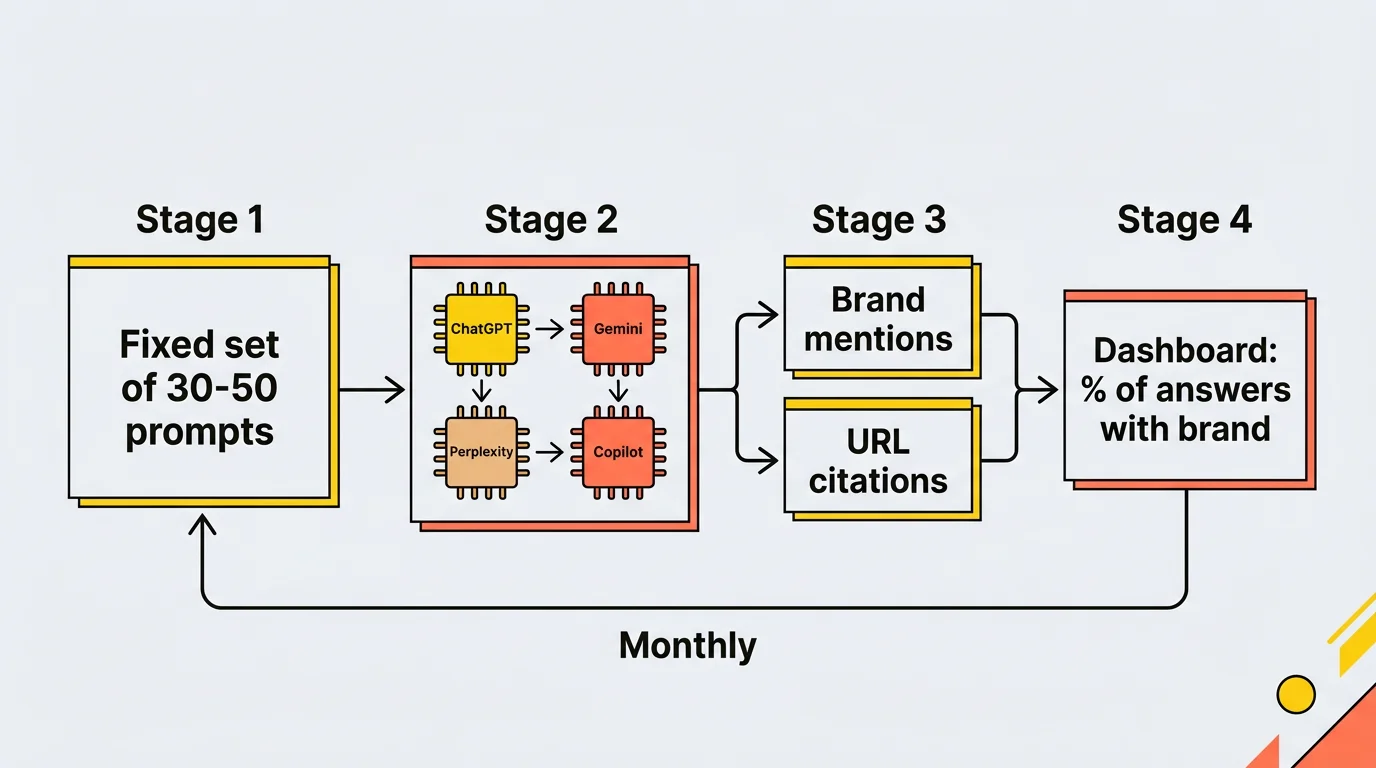
A usable prompt set is 30–50 fixed prompts written the way real buyers ask, split by intent, and kept unchanged between measurement runs — changing prompts mid-series destroys the trend line. Build it in four steps:
- Collect real question phrasings. Pull from sales-call notes, support tickets, People Also Ask boxes, autocomplete, and your keyword research. Write prompts as full conversational questions (“what’s the best project management tool for a 10-person agency?”), not keywords — that is how people talk to chatbots.
- Split prompts by intent, deliberately. Include informational prompts (“how does X work?”), where the realistic goal is a citation of your content, and comparative-commercial prompts (“best X for Y”, “X vs Z”), where the goal is a brand recommendation. The split matters because content type changes outcomes: comparison content generated 2.4 times more brand mentions in AI answers than purely informational content (Semrush and Kevin Indig, 2026).
- Cover the category, not just the brand. Prompts that name your brand (“is X any good?”) measure reputation; unbranded category prompts (“recommend a X”) measure whether engines consider you at all. Most of the set should be unbranded.
- Log a fixed schema per answer. For every prompt × engine run, record: brand mentioned yes/no, brand’s URL cited yes/no, competitors named, sources cited, and the answer text itself. The answer text is what lets you audit sentiment and context later.
What should you count: brand mentions or citations?
Both, as separate KPIs — because in AI answers they are two different phenomena that mostly do not overlap. 61.7% of citations in AI answers are ghost citations: the page’s URL is listed as a source, but the brand is never named in the answer text. Only 38.3% of citations come paired with a brand mention (Semrush and Kevin Indig, 2026; 3,981 domain occurrences across 115 prompts, 14 countries, 4 platforms). A citation (in an AI answer) is a link to your page as a source; a brand mention is your name appearing in the answer text. One drives referral traffic and machine-readable authority; the other drives human awareness. A single “AI visibility score” that blends them hides which one you actually have.
The engines make the separation non-negotiable, because their profiles are inverted (same study):
| Engine | Names the brand in the answer text | Cites the brand’s page as a source |
|---|---|---|
| Gemini | 83.7% of occurrences | 21.4% |
| ChatGPT | 20.7% | 87% |
The same brand, with the same content, can look dominant in Gemini’s answer text and invisible in ChatGPT’s — while quietly powering ChatGPT’s answers as an unnamed source. Averaging across engines would report a bland middle that describes neither.
Why measure per engine instead of one AI score?
Because each engine runs on a different index, cites different sources, and changes on its own schedule. In an analysis of 680 million citations, ChatGPT cited Wikipedia most often (7.8% of all citations), Perplexity leaned on Reddit (6.6%), and Google’s AI Overviews had the most even distribution (Reddit 2.2%, YouTube 1.9%, Quora 1.5%) (Profound, 2025; data August 2024 – June 2025). The architecture enforces this too: Microsoft Copilot is grounded — its answers draw on a live search index rather than training data alone — through “Grounding with Bing Search”, so only pages indexed by Bing can appear in its web-grounded answers (Microsoft Learn, accessed July 2026) — monitoring Copilot visibility without checking your Bing indexation in Bing Webmaster Tools measures an effect while ignoring its cause. The indexation and crawlability groundwork is covered in our guide to preparing your website for generative engines.
Engines also diverge over time, sharply. In 13 weeks of tracking 230,000+ prompts, Reddit’s share of ChatGPT search answers collapsed from roughly 60% in early August 2025 to about 10% by mid-September, and Wikipedia’s from about 55% to under 20% — a shift that coincided with Google removing the num=100 results parameter around September 11, 2025. Over the same weeks, Google AI Mode and Perplexity stayed stable (Semrush, 2025). A brand whose strategy leaned on Reddit threads would have seen its ChatGPT visibility gutted in six weeks while its Perplexity numbers moved nowhere. One blended score cannot surface that; four per-engine trend lines can.
How often should you measure — and why one test proves nothing?
Measure monthly at minimum, with multiple runs per prompt — because a single answer is close to a coin flip. Across 2,961 runs by 600 volunteers on ChatGPT, Claude and Google’s AI Overviews and AI Mode, there was less than a 1-in-100 chance that ChatGPT or Google’s AI returned the same list of brands twice for the same prompt, and less than roughly 1-in-1,000 that it returned the same list in the same order (SparkToro × Gumshoe.ai, 2026; data collected November–December 2025). Screenshotting one ChatGPT answer and reporting “we’re in” or “we’re out” is measurement theater.
The same study shows what is stable: frequency. While individual answers churned, the rate at which given brands appeared across many runs held steady — in narrow categories, leading brands (Bose, Sony, Sennheiser for headphones) appeared in 55–77% of answers, and one niche leader, the City of Hope hospital, appeared in 97% of 71 answers (SparkToro × Gumshoe.ai, 2026). That is the metric worth tracking: AI share of voice — the share of AI answers to a defined prompt set in which the brand appears.
A single AI answer is an anecdote; AI share of voice on a fixed prompt set is a metric. Any monitoring approach that cannot tell you “we appear in X% of answers to these 40 prompts, per engine, this month versus last” is not measuring — it is sampling noise.
Regular cadence also catches platform-level shocks that would otherwise read as your own failure. After ChatGPT updates on March 8 and April 19, 2026, citation volumes fell by 86–94% depending on the market: the share of US answers with zero citations rose from 28% to 48%, and in Germany to 85% — before citations recovered toward pre-March levels in May 2026 (seoClarity, 2026; millions of interactions across 5 markets, February–May 2026). A team measuring monthly saw a platform event and its recovery. A team that tested once in April concluded, wrongly, that its content had stopped working.
AI visibility tools vs DIY: what do you actually need?
DIY is enough to start; scale is what forces the tooling decision. A manual setup — your prompt set, a browser or API scripts, and a logging spreadsheet — delivers a real baseline for one brand, one market and monthly cadence, at the cost of a few hours per run. The market for brand monitoring AI answers has meanwhile split into categories (listed neutrally, without ranking paid products):
- Dedicated AI visibility platforms — purpose-built trackers that run prompt sets across engines on schedule and compute share of voice and citation share.
- AI modules inside SEO suites — established SEO platforms that added AI answer tracking next to rank tracking, convenient when you already pay for the suite.
- Brand mention monitors — media monitoring tools extended to AI answers; relevant because AI visibility correlates with brand mentions across the web (Spearman 0.656–0.709 for ChatGPT, AI Mode and AI Overviews) and on YouTube (~0.737, the strongest single factor measured) far more than with backlinks (0.218) — correlations across 75,000 brands, not causation (Ahrefs, 2025).
- DIY scripts and spreadsheets — full control and zero license cost, limited by API pricing and your time.
The honest argument for paid tools is sample size. Semrush’s 2026 AI Visibility Index analyzed 126 million AI search prompts (Semrush, 2026) — a scale no manual process approaches. If you track one brand in one language on 40 prompts, DIY works. If you track multiple markets, competitors and hundreds of prompts with statistically meaningful repeat runs, manual collection stops being credible before it stops being cheap. If you would rather have the measurement run for you — prompt-set design, monthly per-engine runs, mention and citation KPIs tracked separately, and a trend report with recommendations — that is exactly what our AI visibility monitoring service does: see Vistrix Labs services.
FAQ: monitoring brand visibility in AI answers
Is a single ChatGPT test enough to check my brand’s AI visibility?
No. There is less than a 1-in-100 chance that ChatGPT or Google’s AI returns the same brand list twice for the same prompt (SparkToro × Gumshoe.ai, 2026; 2,961 runs). Only the frequency of appearance across many runs — AI share of voice — is stable enough to act on.
Do my Google rankings tell me how visible I am in AI answers?
Only weakly. Just 12% of links cited by chatbots ranked in Google’s top 10 for the same query, and about 80% ranked nowhere for it (Ahrefs, 2025). Even AI Overviews now draw only 37.9% of citations from the organic top 10, down from 76.1% in July 2025 (Ahrefs, 2026). AI visibility needs direct measurement in the engines themselves.
What is a realistic AI share of voice for a category leader?
In narrow categories, leading brands appeared in 55–77% of AI answers, and one dominant niche player in 97% of 71 answers (SparkToro × Gumshoe.ai, 2026; data November–December 2025). Treat those as the ceiling for tight niches; broad categories fragment across far more brands. Benchmark against your named competitors on the same prompt set, not against an absolute number.