Answer-first content — writing that states the conclusion before the argument — is the single writing habit most consistent with how generative engines select passages to cite. A generative engine is a system that answers with a generated response instead of a list of links (ChatGPT, Perplexity, Google AI Overviews, Copilot), and a citation in an AI answer is a link to a page used as a source within that response. This article is the craft-level workshop of GEO (generative engine optimization) — creating and optimizing content so that it gets cited and used in AI-generated answers: where the answer goes, how to build sentences that survive being lifted out of context, and which structures extraction favors. For the strategy layer above the sentence level, see our guide to generative engine optimization.
What is BLUF, and why does answer-first writing work for AI search?
BLUF (Bottom Line Up Front) is a writing rule from the official US Air Force handbook AFH 33-337, “The Tongue and Quill” (edition of 27 May 2015): state your main point or recommendation at the start of the message, where the bottom line is the one sentence you would keep if you were allowed to keep only one (AFH 33-337, 2015). The military wrote it for busy commanders. It turns out to be a near-perfect description of how to write for AI search.
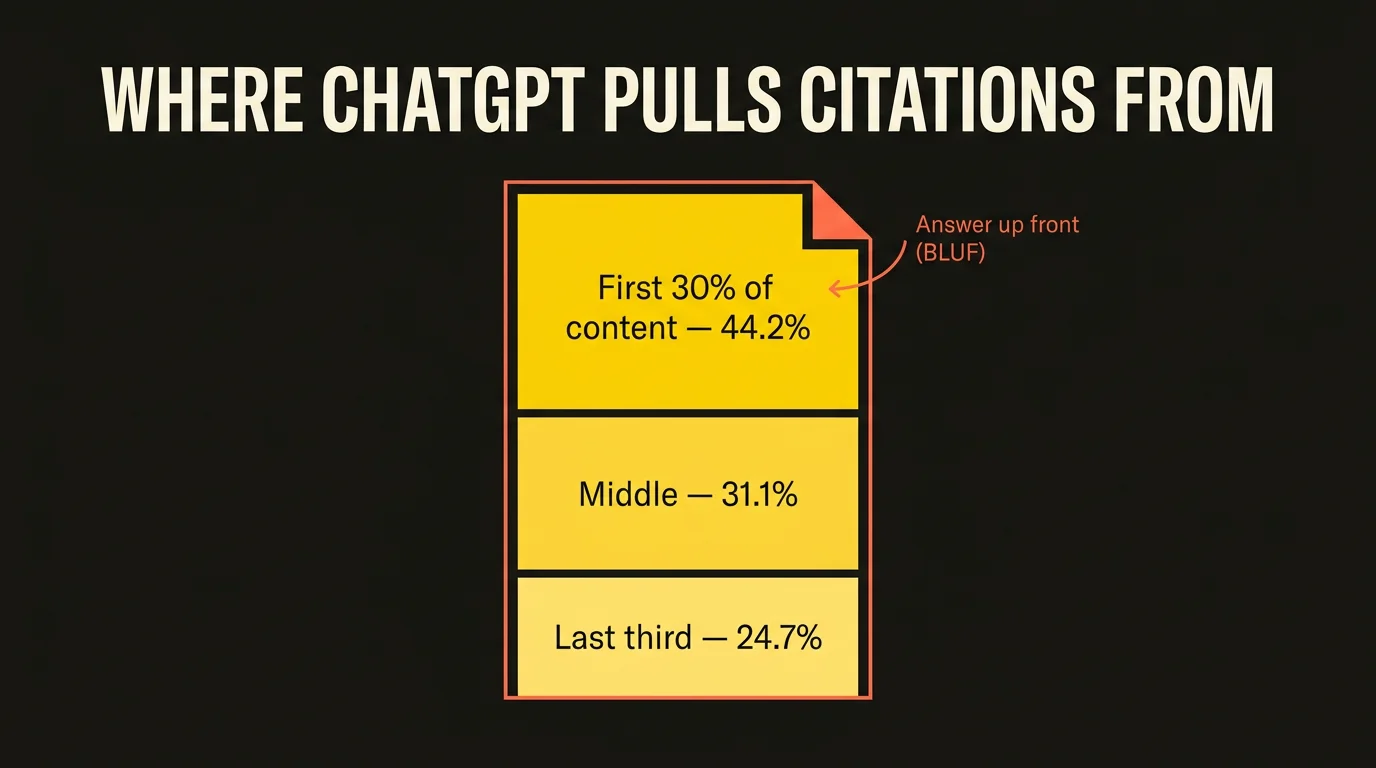
The citation data points the same way. In Kevin Indig’s analysis of 1.2 million AI answers and 18,012 verified ChatGPT citations, 44.2% of citations pointed to the first 30% of a page’s content, 31.1% to the middle (30–70%), and only 24.7% to the final third — as of February 2026 (Search Engine Land, 2026). Two caveats keep this honest: the finding is correlational, not causal, and it describes ChatGPT specifically. But it converges with the broader evidence: a Zyppy meta-analysis of 54 experiments, patents and case studies weighted “answer near the top” at 8.8/10, “intent-format match” at 9.0/10 and “AI-ready structure” (headings, sections, tables) at 8.6/10 — partly based on Dan Petrovic’s research showing Gemini applies a hard retrieval cap per URL, so the opening of the content is what gets read (PPC Land, 2026).
Applied to a blog post, BLUF operates at two levels, not one:
- Article level: a TL;DR block of 40–70 words directly under the headline, containing the main thesis and the single most important number. This is the passage you are offering the model to quote.
- Section level: the first sentence under every H2 answers the heading. Evidence and nuance follow. A reader — or a retrieval system — that stops after one sentence still leaves with the answer.
Classic SEO writing tolerated long warm-up intros because rankings rewarded dwell time and keyword coverage; extraction rewards the opposite. How the rest of the discipline shifts is covered in GEO vs SEO — what actually changes.
How do you write sentences an AI can quote? The lift-out test
A quotable sentence passes the lift-out test: pasted alone into an AI answer, with no surrounding paragraph, it is still true, complete and attributable — which in practice requires a named subject instead of a pronoun, a number where one exists, and a date anchoring that number. Three findings from the ChatGPT citation study justify each part of that rule, all as of February 2026 (Search Engine Land, 2026):
- Definitive constructions win. Passages cited by ChatGPT used definitional phrasing (“X is”, “X refers to”) about 2x more often than non-cited content.
- Named entities win. The most-cited passages averaged 20.6% named entities, versus 5–8% in typical English text. A sentence built on “it” and “this approach” carries no entities to match a query against.
- Plain language wins. Cited content averaged readability grade level 16, versus 19.1 for weakly cited content — simpler sentences beat jargon.
There is a second, more commercial reason to name your subject: ghost citations. A ghost citation is a URL cited as a source without the brand being named in the answer text — and 61.7% of brand appearances in AI answers work exactly that way, while a brand mention — the brand named in the answer text — accompanies only 38.3% of appearances (Semrush and Kevin Indig, 2026; 3,981 domain occurrences across 115 prompts — treat as an order of magnitude). If your key sentence names the subject explicitly, a model that quotes it carries your terminology — and potentially your name — into the answer. If the sentence says “we found” and “it improved”, the quote credits nobody.
The rewrite pattern is mechanical enough to drill. The examples below are invented for illustration — generic sentences of the kind found on thousands of blogs, not excerpts from any real page:
| Before (dies outside its context) | After (passes the lift-out test) |
|---|---|
| “This approach can significantly improve your results over time.” | “BLUF writing places the article’s main conclusion in the first paragraph, before any background.” |
| “It’s one of the most popular tools in this category.” | “Acme Notes is a note-taking app built for teams of 5–50 people.” |
| “They updated the numbers recently, so results may differ.” | “Acme Analytics last updated its pricing benchmark in March 2026.” |
| “Our survey found impressive levels of adoption.” | “The Acme 2026 survey, collected in January 2026 from 1,200 marketers, measured AI tool adoption.” |
Every “after” sentence has a named subject, a definitive verb, and — where a number appears — a time anchor. None of them needs the paragraph around it to be understood, verified or attributed.
A page earns AI citations sentence by sentence: every key claim must remain true, complete and attributable after being lifted out of context, because lifting sentences out of context is precisely what a generative engine does.
Which content structures do AI engines extract most often?
Lists are the most-cited content format in AI answers: listicles account for 21.9% of citations, ahead of articles (16.7%) and product pages (13.7%) — together more than half of all citations — in the Wix AI Search Lab study of 75,000 answers and 1,056,727 citations from ChatGPT, Google AI Mode and Perplexity, as of March 2026 (Wix Studio AI Search Lab, 2026). The same study’s sharper finding: query intent predicts the cited format better than industry or model choice, and for commercial queries listicles alone took 40.86% of citations. The practical rule is intent-format match — enumerable facts go in bulleted or numbered lists, comparisons go in tables, processes go in numbered steps — because the format the engine wants to cite depends on what the user asked, not on what your industry usually publishes.
Question-and-answer structure earns its own place. Content cited by ChatGPT was 2x more likely to be associated with a question mark, and 78.4% of question-linked citations came from headings — as of February 2026 (Search Engine Land, 2026). That is the argument for writing H2 headings as questions in the phrasing real users type, with the answer as the first sentence beneath — BLUF and Q&A structure are the same habit seen from two angles.
One boundary matters: “structure” means visible text, not markup. Google states officially that no special markup or machine-readable files are needed for visibility in AI Overviews and AI Mode — “You don’t need to create new machine readable files, AI text files, or markup” (Google Search Central, 2025). An Ahrefs quasi-experiment adding JSON-LD to 1,885 pages against roughly 4,000 controls found no citation uplift: AI Overviews −4.6% (a small but significant drop), AI Mode +2.4% and ChatGPT +2.2%, both non-significant (Ahrefs, 2026). Structure your text for readers; the machines read the same text.
Do statistics and quotations actually increase AI visibility?
The honest answer is: the evidence is mixed, and a workshop that promises “+40% visibility” is overselling one study. In the peer-reviewed GEO experiment (GEO-bench, 10,000 queries), adding quotations, statistics and source references raised content visibility in generative answers by 30–40% on the Position-Adjusted Word Count metric (Aggarwal et al., KDD 2024), and the authors’ own follow-up on production Perplexity.ai pointed the same direction — quotation addition around +22%, statistics addition around +37% on their metrics (GEO paper v3, 2024). But the independent C-SEO Bench replication (1,900+ queries, 16,300 documents, 4 models) did not confirm the effect: only 3 of 54 cases showed a significant positive result, and the statistics method actually worsened citation ranking in 19 of 24 settings (Puerto et al., NeurIPS 2025).
Two conclusions survive the disagreement. First, the one robust negative: keyword stuffing hurts, cutting visibility by about 9% on GEO-bench and about 10% on production Perplexity.ai (Aggarwal et al., 2024) — writing for AI search is not keyword density with new branding. Second, the reason to cite sources inline is not a guaranteed uplift; it is that a sentence with a source and a date is verifiable, and verifiable sentences are the only ones a careful model — or a careful reader — can safely repeat.
How do TL;DR, FAQ and time anchors complete the workshop?
The finishing layer is a repeatable checklist you can run on any draft before publishing:
- TL;DR up front: 40–70 words directly under the headline, self-contained, carrying the main thesis and the most important number. This is the article-level BLUF.
- Question H2s, answer-first sections: headings phrased as real user questions; the first sentence under each answers it.
- Lift-out test on key claims: named subject, definitive verb, number, date. No sentence that begins with “It” or “This” carries a key claim.
- Intent-format match: at least one list or table wherever the content enumerates or compares; steps as numbered lists.
- Time anchors on every number: “as of {month year}” next to each statistic. AI assistants cite content on average 25.7% fresher than Google’s organic results — 1,064 versus 1,432 days since publication (Ahrefs, 2025) — yet the average cited page is still about 2.9 years old, so the anchor’s job is less “looking fresh” than keeping a number honest when the page outlives it.
- A visible FAQ: 2–4 questions in user phrasing with answers under 80 words. The value sits in the visible Q&A text — since 8 August 2023, Google shows FAQ rich results only for authoritative government and health sites and has retired HowTo rich results entirely (Google Search Central, 2023), so FAQPage markup is hygiene, not the point.
- Plain language pass: shorter sentences, fewer abstractions — cited content averaged grade level 16 versus 19.1 for weakly cited content (Search Engine Land, 2026).
Writing is half the job: a perfectly quotable page still needs to be technically readable to AI crawlers — server-rendered text, open robots.txt, clean HTML — which we cover step by step in how to prepare a website for generative engines. And if you want to know whether AI engines already cite your pages — and which sentences they lift — that is exactly what an AI visibility audit measures across ChatGPT, Perplexity, Gemini and Copilot; the scope is described in Vistrix Labs services.
FAQ: writing answer-first content for AI search
What is answer-first content?
Answer-first content states the conclusion in the first sentence of the article and of every section, with evidence and nuance following — the BLUF principle codified in the US Air Force handbook AFH 33-337 (The Tongue and Quill, 2015). Citation data supports it: 44.2% of verified ChatGPT citations pointed to the first 30% of a page’s content, as of February 2026 (Search Engine Land, 2026).
How do I test whether a sentence is quotable?
Run the lift-out test: paste the sentence alone into an empty document and check that it is still true, complete and attributable — named subject instead of a pronoun, a number where one exists, and a date anchoring the number. Passages ChatGPT cited used definitional phrasing (“X is”, “X refers to”) about 2x more often than non-cited content (Search Engine Land, 2026).
Do I need FAQPage schema for AI to use my FAQ?
No. Google states no special markup is required for its AI features (Google Search Central, 2025), an Ahrefs quasi-experiment on 1,885 pages found no citation uplift from adding schema (Ahrefs, 2026), and FAQ rich results have been restricted to government and health sites since August 2023. Write the questions and answers as visible text.