
This article is a living benchmark of AI search statistics: adoption numbers for every major generative engine, how often AI Overviews appear in Google results, what they do to click-through rates, and how much referral traffic ChatGPT and Perplexity actually send. Every number below carries a source, a measurement date, and the methodological context you need to use it safely — because in AI search data, a statistic without a date is misinformation. AI data ages in months, not years, so we review this page quarterly. Data reviewed as of .
How big is AI search in 2026?
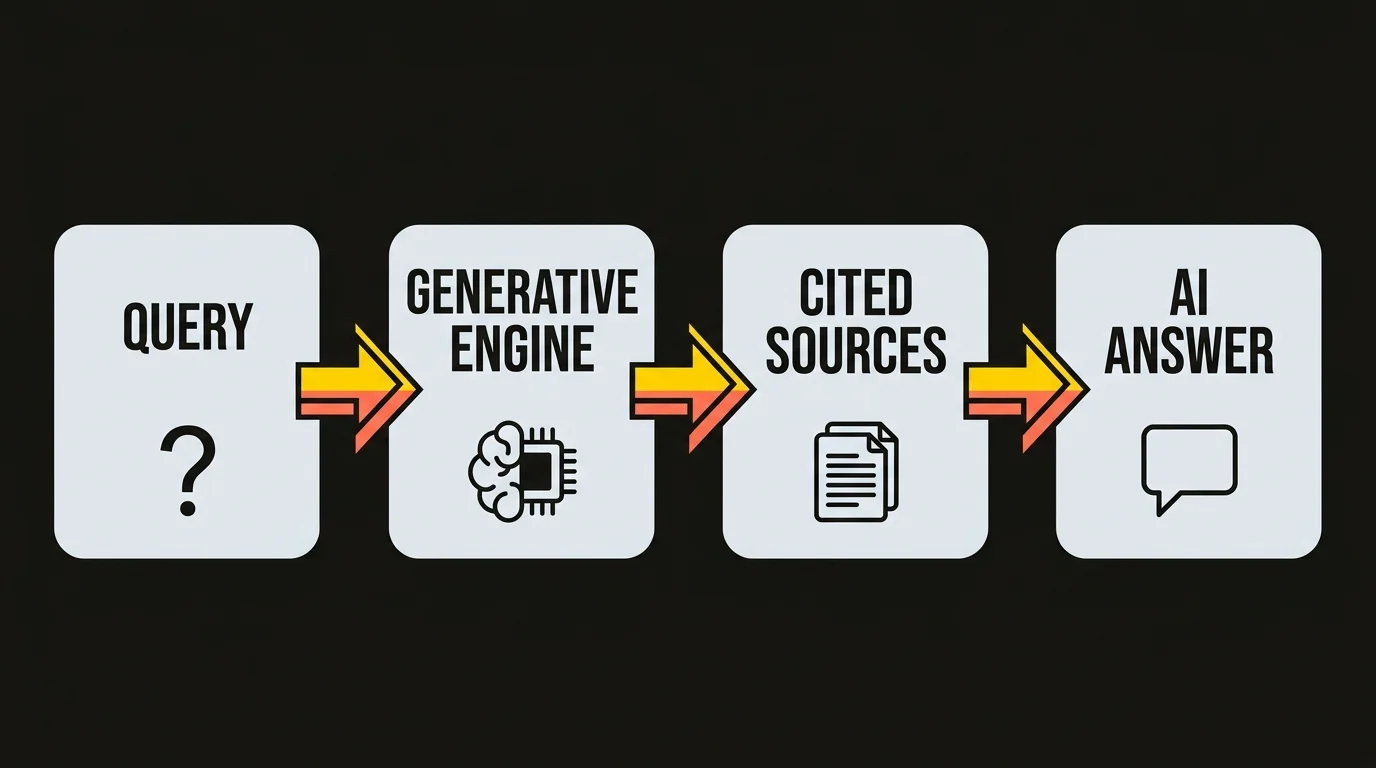
AI search now operates at mass-media scale: ChatGPT reports 900 million weekly active users (OpenAI announcement of February 27, 2026, via TechCrunch) and Google’s AI Overviews reach more than 2 billion monthly users (Alphabet Q2 2025 earnings, July 2025). A generative engine — a system that answers with a generated response instead of a list of links (ChatGPT, Perplexity, Google AI Overviews, Copilot) — is no longer an early-adopter channel. This scale is the reason GEO (generative engine optimization) — creating and optimizing content so that it gets cited and used in AI-generated answers — has become a discipline of its own. If you are new to the field, start with our complete guide to generative engine optimization and come back here for the numbers.
ChatGPT: 900 million weekly active users
OpenAI announced on that ChatGPT has 900 million weekly active users (WAU) and 50 million paying subscribers, up from 800 million WAU in October 2025 (TechCrunch, 2026). That is 100 million additional weekly users in under five months. One comparability caveat: OpenAI reports weekly actives while Google reports monthly actives, and WAU is the stricter metric — it measures habitual use, not occasional visits — so the two sets of numbers should not be stacked side by side as if they were the same unit.
Google: AI Overviews, AI Mode, and the Gemini app
Google plays in three categories at once, and each has its own number. AI Overviews — the AI-generated summaries above Google search results — serve more than 2 billion monthly users across 200+ countries, AI Mode has passed 100 million monthly active users in the US and India, and where AI Overviews appear, they drive over 10% more queries, according to Sundar Pichai’s remarks on the Alphabet Q2 2025 earnings call (July 23, 2025). As recently as May 2025 the AI Overviews figure was 1.5 billion, so the growth rate is measured in hundreds of millions of users per quarter.
The Gemini app is a separate growth line: 750 million monthly active users in Q4 2025, up from 650 million in Q3 2025 and 450 million in Q2 2025 (Alphabet Q4 2025 earnings, via TechCrunch, February 2026). That is a two-thirds increase in six months.
Perplexity: 780 million queries per month
Perplexity handled 780 million queries in May 2025 — roughly 30 million per day — and was growing more than 20% month over month, according to CEO Aravind Srinivas at the Bloomberg Tech Summit (TechCrunch, June 2025). A methodological note that matters: this is the last official query count Perplexity has published (as of July 2026). Newer figures circulating online — 1.2 to 1.5 billion queries per month — are estimates with no primary source, and this benchmark does not cite them.
| Engine | Scale | Measured | Source |
|---|---|---|---|
| ChatGPT | 900M WAU; 50M paying subscribers | OpenAI / TechCrunch | |
| Google AI Overviews | 2B+ monthly users, 200+ countries | Alphabet Q2 2025 | |
| Google AI Mode | 100M+ MAU (US and India) | Alphabet Q2 2025 | |
| Gemini app | 750M MAU | Q4 2025 (reported ) | Alphabet Q4 2025 / TechCrunch |
| Perplexity | 780M queries/month | May 2025 | Perplexity CEO / TechCrunch |
The metrics in this table are deliberately not normalized. WAU, MAU, and query counts are different units, each company reports what flatters it, and an honest benchmark shows the seams instead of papering over them.
How often do AI Overviews appear in Google results?
In November 2025, AI Overviews appeared for 15.69% of tracked keywords — after climbing from 6.49% in January 2025 to a peak of 24.61% in July 2025 (Semrush AI Overviews Study, 10M+ keywords, data January–November 2025). The swing is not measurement noise: it reflects Google aggressively testing and rolling back AI Overviews across query categories. The practical takeaway is that any single-month “share of queries with an AI Overview” figure is a snapshot, not a constant — quote it with its month or not at all.
User-level data tells a slightly different story than keyword-level tracking. In March 2025, 18% of all Google searches performed by a monitored panel produced an AI summary, and 88% of those summaries cited at least three sources (Pew Research Center, July 2025; panel of 900 US adults, 68,879 unique searches). The gap between Pew’s 18% (real user behavior, US only) and Semrush’s keyword-based percentages illustrates the first rule of this dataset: before you compare two AI search statistics, check what each one actually measured.
What do AI Overviews do to click-through rates?
Every credible measurement points the same direction: when an AI Overview appears, clicks to websites fall — the studies disagree only about how much. Pew Research Center found that users clicked a traditional result on 8% of searches with an AI summary versus 15% without one, clicked a source link inside the AI summary on just 1% of visits, and ended their browsing session entirely on 26% of AI-summary searches versus 16% without (Pew Research Center, July 2025, data from March 2025). Disclosure required for fair use of this study: Google has publicly disputed the study’s methodology. Cite the numbers with that caveat attached.
Ahrefs measured the same effect from the publisher’s side, using aggregated Google Search Console data across 300,000 keywords (150,000 triggering AI Overviews plus 150,000 controls). The presence of an AI Overview correlated with a 58% lower click-through rate for the #1 ranking page in December 2025 data — a deterioration from the 34.5% reduction the first edition of the study found in March–April 2025 data. In absolute terms, for keywords that now trigger an AI Overview, desktop CTR for position 1 fell from 0.073 in December 2023 (before AI Overviews rolled out) to 0.016 in December 2025 (Ahrefs, February 2026, data December 2025). Two independent methodologies, one conclusion: the cost of an AI Overview sitting above your #1 ranking is no longer hypothetical, and it grew over 2025.
If your organic traffic depends on informational keywords, this is the section that should change your roadmap. Measuring where your brand stands in AI answers — before deciding what to fix — is exactly what an AI visibility audit does; see our GEO services if you want that baseline established for your domain.
Who gets cited in AI Overviews?
Ranking well still helps, but its grip is loosening quarter by quarter. A citation in an AI answer is a link or reference to a page as a source within the generated response — and the pool those citations are drawn from is widening. In July 2025, 76.1% of AI Overview citations came from pages ranking in Google’s top 10 for the query; by March 2026 that share had fallen to 37.9%, with 31.2% of citations coming from positions 11–100 and 31.0% from pages ranking outside the top 100 entirely (Ahrefs, March 2026; 863,000 keywords, 4 million URLs). One honesty note before you quote the trend: part of that drop is methodological — the 2025 edition counted only the top three visible citations, while the 2026 edition counts all of them. The direction is real; the exact magnitude of the decline is not cleanly comparable.
Position still correlates strongly with citation at the top of the distribution. As of October 2025, 94% of AI Overviews cited at least one URL from the organic top 20, a page ranking #1 appeared in the AI Overview 43% of the time, and a page ranking #20 appeared 7% of the time (seoClarity, October 2025; 362,000 US queries). Read together with the Ahrefs data, the picture is consistent: top rankings remain the single best predictor of AI Overview citations, but they are a shrinking share of the citation pool — an expanding long tail of sources gets cited without ranking at all.
One domain deserves its own line item: YouTube is the single most-cited domain in AI Overviews, accounting for 5.6% of all AI Overview citations, up 34% in six months (Ahrefs, March 2026). If your content strategy has no video component, you are absent from the most-cited property in the most-used AI search surface.
ChatGPT traffic data: what does referral traffic actually look like?
ChatGPT referral traffic changed regime overnight in May 2026, which makes every pre-May benchmark obsolete. After OpenAI’s interface update of made brand links in answers visibly clickable, ChatGPT referral traffic to websites grew 157.7% week over week, the share of referred visits landing on brand homepages jumped from 26–32% to roughly 60%, and pages per visit rose from 3.8 to 4.7 (Similarweb, May 2026; desktop clickstream panel, April 30 – May 20, 2026). Two things follow. First, any “ChatGPT sends negligible traffic” claim based on 2025 data is out of date. Second, the composition changed along with the volume: post-update ChatGPT traffic behaves more like branded navigation (homepage entries, deeper sessions) than like classic long-tail organic landings.
Where ChatGPT sends users is a different question from where Google ranks them. Only 12% of links cited by AI chatbots (ChatGPT, Gemini, Copilot) rank in Google’s top 10 for the same query; per engine, the overlap is 28.6% for Perplexity, 8.6% for Copilot, 8.2% for Gemini, and 8.0% for ChatGPT’s in-text citations — and roughly 80% of chatbot citations rank nowhere in Google at all (Ahrefs, August 2025; 15,000 long-tail queries). This is the strongest quantitative argument that GEO is not a rebranding of SEO: the engines draw from substantially different source pools. We unpack the strategic consequences in GEO vs SEO: what actually changes.
Freshness is one measurable difference in what chatbots select. AI assistants (ChatGPT, Perplexity, Gemini, Copilot) cite content that is on average 25.7% fresher than Google’s organic results — 1,064 days old versus 1,432 days — with ChatGPT citations averaging 958 days; the exception is AI Overviews, whose citations match the age profile of the classic SERP at about 1,432 days (Ahrefs, July 2025; 16.975 million cited URLs across 7 platforms).
Perplexity in numbers: the engine closest to Google’s playbook
Perplexity reports its scale in queries rather than users, and it is the most “Google-like” of the major engines in what it cites. Its official scale marker remains 780 million queries in May 2025 with 20%+ month-over-month growth (Perplexity CEO Aravind Srinivas, via TechCrunch, June 2025). And in the Ahrefs overlap study, 28.6% of Perplexity’s citations ranked in Google’s top 10 for the query — more than triple the overlap of ChatGPT, Gemini, or Copilot (Ahrefs, August 2025). The practical read: content that already ranks in Google has the shortest path to Perplexity citations, while ChatGPT and Copilot visibility has to be earned through channels that classic rankings do not capture.
Gemini and Copilot: mentions, citations, and the ghost citation problem
Gemini and Copilot publish little first-party data, so the best available numbers describe how they cite rather than how many people use them (the Gemini app’s 750M MAU, covered above, is the exception). The most consequential finding: 61.7% of citations in AI answers are ghost citations — the page is linked as a source, but the brand is never named in the answer text (Semrush and Kevin Indig, June 2026; 3,981 domain occurrences across 115 prompts, 14 countries, 4 platforms). The engines diverge sharply: Gemini names brands in 83.7% of relevant answers but links them as sources in only 21.4%, while ChatGPT is the mirror image — citing in 87% of cases but naming the brand in just 20.7%. The sample is moderate, so treat these as orders of magnitude rather than precise rates.
The measurement consequence is not optional: brand mentions and citations are separate KPIs and must be tracked separately, per engine. A dashboard that counts only linked citations will systematically overstate your visibility in ChatGPT and understate it in Gemini — and vice versa for a mentions-only tracker.
Every AI search statistic is a photograph, not a portrait: accurate for the month it was taken, misleading a quarter later. The date of measurement is part of the number.
What is AI search traffic worth?
Fewer visits, but measurably more valuable ones — that is the current trade-off in the data. The average visitor arriving from AI search converts at 4.4 times the rate of a visitor from traditional organic search, and for a set of 500+ digital marketing topics, Semrush projects AI search traffic could overtake traditional organic traffic in early 2028 (Semrush, July 2025). Handle those two numbers differently: the 4.4x conversion multiple is a measurement; the 2028 crossover is an extrapolation of current growth curves and should be communicated as a forecast, never as a fact. Extrapolations in this market have a short shelf life — the same caveat this entire article keeps repeating.
The engagement data points the same way. Post-update ChatGPT referrals browse 4.7 pages per visit, up from 3.8 (Similarweb, May 2026) — behavior closer to a pre-qualified prospect than a drive-by informational click. The strategic summary of this whole benchmark fits in one sentence: AI search delivers fewer clicks per impression than the classic SERP ever did, from a source pool that overlaps Google’s rankings less every quarter, and the visits it does deliver are worth several times more.
How to use this benchmark without misleading anyone
Three rules keep these numbers honest when you reuse them. First, always attach the measurement date — “AI Overviews trigger on 15.69% of keywords” is false as a timeless claim and true as a November 2025 snapshot (Semrush, 2025). Second, name the unit: WAU is not MAU, keyword share is not user-level share, a citation is not a brand mention. Third, carry the caveats with the numbers — Google disputes Pew’s methodology, the Ahrefs citation-share trend includes a methodology change, the ghost citations sample is moderate, and the 2028 crossover is a forecast. A statistic quoted without its limitations stops being data and becomes marketing.
This page is reviewed quarterly against primary sources, and superseded figures are replaced with dated updates. If a number here has a newer official successor we missed, the correction policy is simple: we fix it and mark the change.
FAQ
What share of Google searches trigger an AI Overview?
It depends on how you measure. Keyword-level tracking showed 15.69% of keywords triggering AI Overviews in November 2025, down from a 24.61% peak in July 2025 (Semrush, 2025). User-level panel data showed 18% of real Google searches producing an AI summary in March 2025 (Pew Research Center, 2025). Both are valid; they measure different things.
How much traffic does ChatGPT send to websites?
More than it did, and growing fast: after the interface update of May 7, 2026 made brand links clickable, ChatGPT referral traffic rose 157.7% week over week, with about 60% of visits landing on brand homepages and 4.7 pages viewed per visit (Similarweb, May 2026). Absolute volumes vary by site and industry — measure your own referrals under the chatgpt.com referrer.
Do high Google rankings guarantee AI citations?
No. They help most in AI Overviews — a #1 ranking appeared in the AI Overview 43% of the time as of October 2025 (seoClarity, 2025) — but only 12% of links cited by AI chatbots rank in Google’s top 10 for the query, and about 80% rank nowhere in Google (Ahrefs, 2025). Rankings are one input, not a guarantee.