
TL;DR: Schema markup is not a ticket into AI answers. Google states that no special structured data is needed for AI Overviews, and the only large causal test (Ahrefs, 2026: 1,885 pages) found no citation uplift — AI Overviews citations actually fell 4.6%. Schema still earns its keep as machine hygiene: Bing’s LLMs use it, Google serves it to models during fan-out, and data-driven result features require it.
Do you need schema markup to appear in AI search?
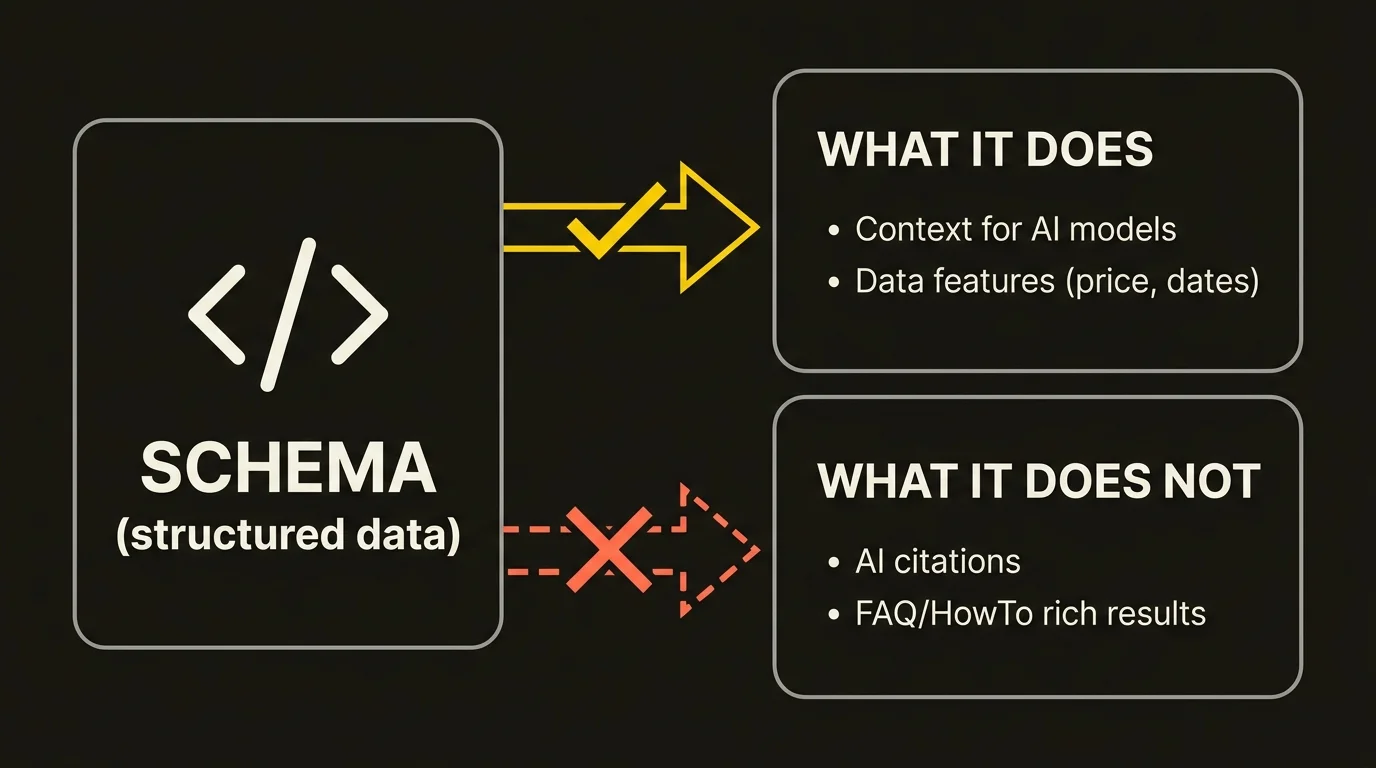
No. Google’s own documentation on AI features says it twice, in plain language: “You don’t need to create new machine readable files, AI text files, or markup to appear in these features” and “There’s also no special schema.org structured data that you need to add” (Google Search Central, updated December 2025). That covers AI Overviews — the AI-generated summaries shown above Google’s search results — and AI Mode. If an agency pitch starts with “you need schema to show up in AI”, it contradicts the primary source on page one.
The FAQ schema story makes the point even sharper. On 8 August 2023 Google announced that FAQ rich results would only be shown for “well-known, authoritative government and health websites”, and that HowTo rich results would be limited to desktop before being deprecated entirely (Google Search Central Blog, 2023). Then the exception disappeared too: Google’s changelog entry of 8 May 2026 states that FAQ rich results “will no longer appear in Google Search starting May 7, 2026” — for anyone, government and health sites included — and the FAQ rich result documentation was removed on 15 June 2026 (Google Search Central documentation updates, 2026).
So as of July 2026, the two schema types most aggressively sold as “AI optimization” — FAQPage and HowTo — produce zero visible features in Google Search. The markup does no harm: Google confirmed in the same 2023 announcement that unused structured data “does not cause problems for Search, but also has no visible effects in Google Search” (Google Search Central Blog, 2023). It just no longer buys what it is being sold for.
Does structured data increase AI citations?
The best available evidence says no — the correlation is real, the causation is not. A citation (in an AI answer) is a link or reference to a page as a source within a generated answer; that is the metric at stake here. Ahrefs analyzed 6 million URLs and found that pages cited by AI are almost 3x more likely to carry JSON-LD than uncited pages (Ahrefs, 2026). The authors’ own interpretation: co-occurrence, not cause — well-maintained, authoritative sites tend to have both schema and citations.
The same Ahrefs study ran the only large quasi-experiment to date on schema and AI citations: 1,885 pages that added JSON-LD between August 2025 and March 2026, compared against roughly 4,000 matched control pages (3 controls per page, 30-day windows before and after). The results, by engine (Ahrefs, 2026):
| Engine | Change in citations after adding JSON-LD | Statistically significant? |
|---|---|---|
| Google AI Overviews | −4.6% | Yes (odds of chance ~1 in 2,500) |
| Google AI Mode | +2.4% | No |
| ChatGPT | +2.2% | No |
The authors’ conclusion is worth quoting in full: “If the only reason you’re adding it is to get more AI citations on pages that are already visible, our data doesn’t support that bet” (Ahrefs, 2026). One honest caveat cuts both ways: the sample consisted of pages that were already heavily cited, so the study does not settle what schema does for pages just entering visibility.
The academic record points the same direction. The peer-reviewed GEO paper (KDD 2024) — the source of the famous “up to 40% visibility” figure — never tested schema or structured data at all; its nine methods were all modifications of visible text, such as quotations, statistics and fluency (Aggarwal et al., KDD 2024). Citing that paper as proof that schema markup works is a misuse of the source. C-SEO Bench (NeurIPS 2025) tested 10 “LLM optimization” methods across 1,900+ queries and 16,300 documents and found a significant positive effect in only 3 of 54 cases; the authors conclude that “most current C-SEO methods are not only largely ineffective but also frequently have a negative impact on document ranking” and that traditional SEO is significantly more effective (Puerto et al., NeurIPS 2025). The one study that flatters structured data — GEO-16, which found it among the three strongest correlates across 1,702 citations from 3 answer engines — is an unreviewed, observational preprint limited to English-language B2B SaaS pages: correlation again, not causation (GEO-16, arXiv preprint, 2025).
What does structured data actually do for machines?
Structured data (schema.org) — machine-readable markup describing your content — is machine hygiene: it disambiguates entities cheaply and unlocks specific data-driven features. Per Google’s documentation, structured data provides “explicit clues about the meaning of a page” and is a hard requirement for concrete features: recipe details, product snippets with price and availability, job postings, events, review snippets, video features (Google Search Central, updated December 2025). Google’s own case studies from the pre-AI era — Rotten Tomatoes +25% CTR on marked-up pages, Food Network +35% more visits — belong to that classic rich-results world, not to AI answers.
Asked directly whether schema helps LLMs, Google’s John Mueller gave the accurate, unsatisfying answer: “the short answer is yes, no, and it depends” — critical for data-driven features like prices, shipping and availability in Shopping, mostly result enrichment elsewhere (Search Engine Roundtable, 2026). That is a nuanced statement, not an endorsement of “schema = citations”.
There are, however, two first-party confirmations that generative engines — systems that answer with a generated response instead of a list of links (ChatGPT, Perplexity, Google AI Overviews, Copilot) — read schema, and they define its realistic value:
- Microsoft: Fabrice Canel, Principal Product Manager at Bing, confirmed at SMX Munich in March 2025 that Microsoft uses schema markup to help its LLMs — including Copilot — understand content, adding that “Gen AIs value fresh content in particular, partly as a reference check of their LLM training data” and recommending IndexNow (Search Engine Land, 2025; core statement reported and validated by Canel on LinkedIn rather than a verbatim transcript). This matters because Microsoft Copilot’s grounding — basing answers on a live index rather than training data alone — runs through Bing Search: only Bing-indexed pages can appear in Copilot answers (Microsoft Learn, accessed July 2026).
- Google: Ryan Levering, Google engineer for structured data, said at Search Central Live Toronto in April 2026 — per session reports — that “Schema is used as context served to models when doing fanouts”: when AI Mode and AI Overviews fan a query out into sub-queries, structured data is served to the models as context, because parsing it is cheaper for Google than repeatedly inferring meaning from raw text (Suganthan, session report, 2026).
Read those two statements precisely: machines use schema to understand and process content more cheaply. Neither says schema increases your probability of being cited — the Ahrefs experiment tested exactly that and came up empty.
What should you implement — and how?
Implement schema as technical hygiene with a clear feature rationale, in this order:
- Ship it server-side, in the HTML. No major AI crawler renders JavaScript: the Vercel and MERJ study of production traffic (including 569 million GPTBot requests and 370 million Claude requests per month) found that “None of the major AI crawlers currently render JavaScript” — bots download JS files but never execute them, with Googlebot’s rendering infrastructure and AppleBot as the exceptions (Vercel, 2024). JSON-LD injected client-side is invisible to GPTBot, ClaudeBot and PerplexityBot.
- Make the markup match the visible text. Google requires that structured data match what users see on the page — markup describing content the user cannot see violates the guidelines. Tellingly, this is the only schema-related instruction Google’s AI-features document actually gives (Google Search Central, updated December 2025).
- Cover the identity and content basics: Organization, Person (authors with real bios), BlogPosting or Article with dates and abstract, BreadcrumbList. This is cheap entity disambiguation — the “explicit clues” Google describes.
- Prioritize data-feature schema if you sell or list things: Product with price and availability, JobPosting, Event, Recipe, Review. This is where schema is a genuine requirement with a visible payoff, per Google’s documentation and Mueller’s “yes” case.
- Keep visible Q&A and step-by-step text; stop expecting FAQPage and HowTo markup to render anything. The extractable value lives in the visible answer text, not in the markup — and since May 2026 the FAQ rich result no longer exists for anyone (Google Search Central, 2026).
- Get indexed in Bing. Verify in Bing Webmaster Tools and push URLs via IndexNow — Bing indexation is a documented precondition for appearing in Copilot answers, and the one place a platform has confirmed its LLMs consume your schema (Microsoft Learn, accessed July 2026).
An afternoon of clean JSON-LD is a sensible investment. An expensive “AI schema optimization” retainer is not — the levers that actually move AI visibility are content quality, retrieval position and brand presence across sources, which we break down in our generative engine optimization guide. If you would rather measure than guess, an AI visibility audit shows where your brand appears in AI answers today and which gaps are worth real money — book an AI visibility audit before you sign anything that promises citations from markup.
Why do agencies still sell schema as AI magic?
Because schema is auditable, billable and easy to demonstrate in a validator — unlike the slow work that actually correlates with citations. GEO (generative engine optimization) — creating and optimizing content so that it gets cited and used in AI-generated answers — is a young discipline, and young disciplines attract vendors selling deterministic fixes for probabilistic systems. Schema markup fits the pitch perfectly: it produces a green checkmark the client can see, whether or not it changes a single answer.
Schema is plumbing, not persuasion. Machines read it to parse your pages more cheaply — no evidence shows they reward you for it with citations. Pay for plumbing at plumbing prices.
The pattern has a fresh twin: llms.txt — a proposed standard for a file mapping a site’s key content for AI systems. Per Ahrefs’ study of 137,000 domains (updated June 2026), 28% publish a valid llms.txt — yet 97% of those files received zero requests in May 2026, and “no major LLM provider currently supports llms.txt. Not OpenAI. Not Anthropic. Not Google” (Ahrefs, 2026). John Mueller compared llms.txt to the keywords meta tag back in April 2025, and since June 2026 Google’s documentation notes that llms.txt files aren’t needed for Google Search and won’t affect visibility or rankings either way. Machine-readable files are seductive deliverables precisely because they are easy to produce and impossible for the client to falsify. The discipline that separates a generative engine from a checkbox audit is measurement per engine, per month; the strategic shift behind it is covered in GEO vs SEO: what actually changes.
FAQ
Is FAQ schema dead in 2026?
As a Google Search feature, yes. FAQ rich results stopped appearing for ordinary sites in August 2023 and were fully deprecated for everyone — including government and health sites — on 7 May 2026 (Google Search Central, 2026). The visible Q&A text remains valuable for extraction; the FAQPage markup itself no longer renders anything.
Should I remove existing FAQ or HowTo markup?
No — there is no need. Google stated when deprecating these features that unused structured data “does not cause problems for Search, but also has no visible effects in Google Search” (Google Search Central Blog, 2023). Leave it or remove it during routine cleanups; just stop paying anyone to add it as an “AI visibility” tactic.
Does schema help ChatGPT or Copilot cite my site?
For Copilot, schema plausibly helps comprehension: Bing confirmed its LLMs use schema markup (Search Engine Land, 2025), and Copilot only surfaces Bing-indexed pages. For ChatGPT, the Ahrefs quasi-experiment found a +2.2% citation change after adding JSON-LD — statistically insignificant (Ahrefs, 2026). Treat schema as comprehension support, not a citation lever.