
AI share of voice is the share of AI answers, across a fixed set of prompts, in which your brand appears — the one stable number in a channel where any single answer is close to random. This article defines the metric precisely, shows the two ways it is actually calculated, and explains why a credible measurement separates brand mentions from citations and reports one figure per engine and per market rather than a single blended score. It is the scoreboard metric of GEO (generative engine optimization) — creating and optimizing content so that it gets cited and used in AI-generated answers.
What is AI share of voice?
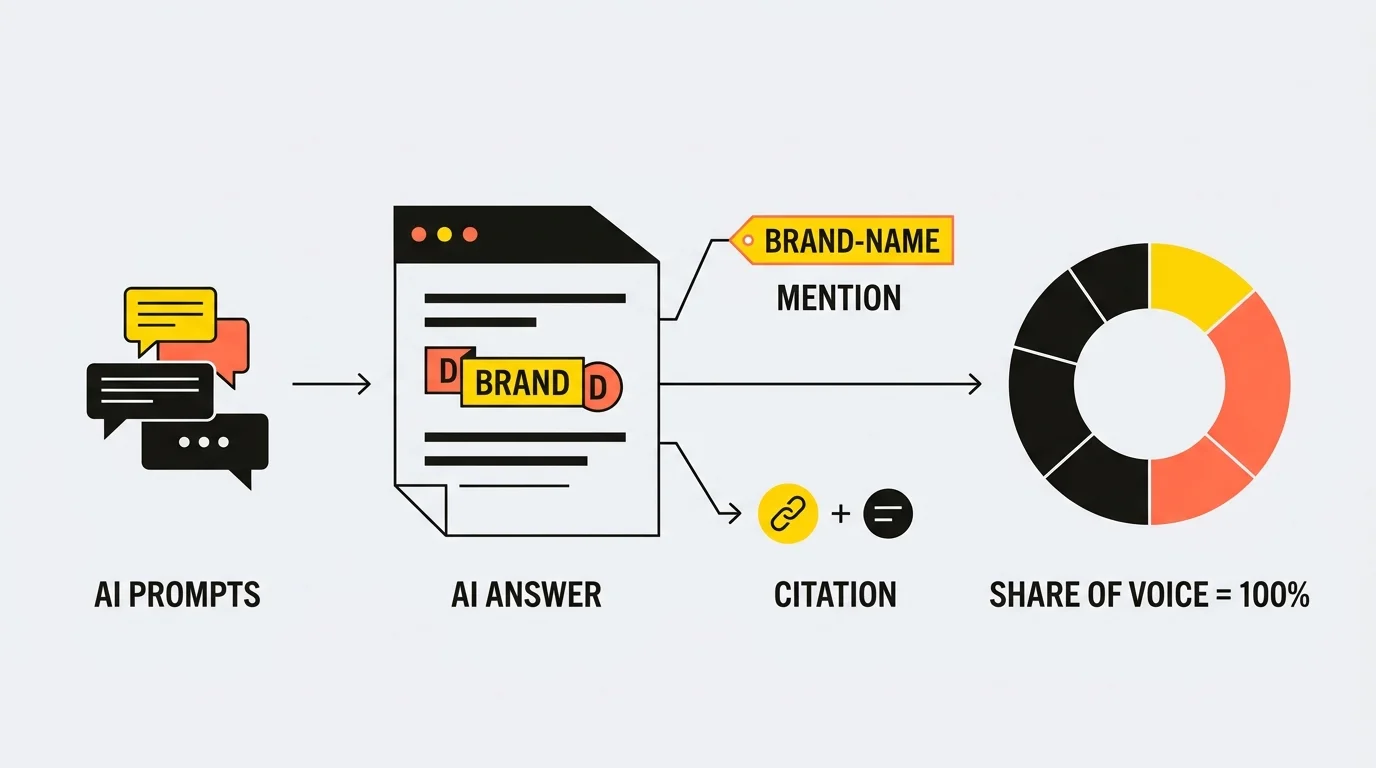
AI share of voice is the percentage of AI answers to a defined prompt set in which a brand appears, measured relative to its competitors in the same category. Semrush defines it as how visible a brand is in AI responses “based on how often it’s mentioned and how high it appears in answers relative to competitors”, and it is deliberately zero-sum: AI share of voice across all brands in a category adds up to 100% (Semrush, 2025). That last property is what makes it a competitive metric rather than a vanity count. Your brand share of AI answers only rises if a rival’s falls — so the number answers the question executives actually ask, which is not “are we visible?” but “are we more visible than them?”
Two entities sit underneath the metric and are constantly confused. A brand mention is your name appearing in the AI answer text, whether or not a link is attached. A citation (in an AI answer) is your page being listed as a source, whether or not your name appears in the visible text. Share of voice is usually built on the first — presence in the answer the human reads — but as the next sections show, the two rarely travel together, and a measurement that blends them tells you nothing you can act on.
How is AI share of voice calculated?
Two inputs drive it: how often a brand is mentioned, and how high in the answer those mentions sit. In Semrush’s AI Visibility Toolkit method, the share-of-voice calculation factors in both the number of a brand’s mentions and their position within the AI answer, so a brand named first in a response counts for more than one buried in a closing list; the ChatGPT (Enterprise AIO) variant additionally weights the topic’s search volume, giving high-demand queries more influence over the score (Semrush, 2025). Position weighting matters because AI answers are read top-down and rarely in full — first mention is not the same as fifth.
The do-it-yourself version is simpler and still valid: run a fixed prompt set through an engine, count the answers your brand appears in, and divide by the total number of answers. A brand named in 24 of 40 answers has a 60% raw share of voice on that set, for that engine, that month. The result is only meaningful with three qualifiers attached — which engine, which market, and how many repeat runs — for reasons the rest of this article makes concrete.
Why does measuring share of voice mean separating mentions from citations?
Because in AI answers a brand can be the source without ever being named, and being named without being the source. In a study of AI citations, 61.7% were ghost citations — the page was used as a source link, but the brand name never appeared in the actual answer text — leaving only 38.3% of citations paired with a visible brand mention (Semrush and Kevin Indig, 2026; 3,981 domain occurrences across 115 prompts, 14 countries and 4 generative engines, each occurrence tagged separately as “cited” and “mentioned”). A ghost citation is a URL cited as a source without the brand being named in the answer text — traffic and machine-readable authority, but zero human awareness. Share of voice built on mentions and share of voice built on citations are therefore two different numbers, and reporting one as if it were the other is the most common measurement error in this field.
The gap widens once you split by engine, because the engines behave in opposite directions on the same underlying data (same study):
| Engine | Names the brand in the answer text | Cites the brand’s page as a source |
|---|---|---|
| Gemini | 83.7% of occurrences | 21.4% |
| ChatGPT | 20.7% | 87% |
The same brand, with the same content, can look dominant in Gemini’s answer text and near-invisible in ChatGPT’s — while quietly powering ChatGPT’s answers as an unnamed source. A single “AI visibility score” that averages the two describes neither. The full mechanics of this split, and why it happens, are covered in our breakdown of ghost citations in AI answers.
How do you measure your own AI share of voice?
You run a fixed set of prompts through each engine on a schedule, log whether your brand appears, and track the appearance rate over time — mentions and citations as separate KPIs. The mechanics of building the prompt set, choosing a cadence and deciding between spreadsheets and dedicated tooling are a topic in themselves, covered step by step in our guide to monitoring brand visibility in AI answers. Two design choices, though, directly shape the share-of-voice number and belong here.
- Weight the prompt set by intent, because query type changes the outcome. Comparative prompts (“best X for Y”, “X vs Z”) produced a 43.3% brand-mention rate, while purely informational prompts produced 18% — roughly 2.4 times more brand mentions from comparative content, even though informational prompts hit an 89.3% citation rate (Semrush and Kevin Indig, 2026). A prompt set skewed toward “how does X work” will report a low mention-based share of voice by construction; one skewed toward comparisons will report a high one. Decide the mix deliberately and keep it fixed between runs.
- Measure per market, not globally. Brand-mention rates in the same study ranged from about 50% of AI answers in India and Sweden to just 18–22% in Italy, Brazil and the Netherlands (Semrush and Kevin Indig, 2026). A global average would misstate your share of voice in every individual market you care about.
Why is AI share of voice measured per engine, not as one number?
Because each engine runs on a different index, cites different sources, and changes on its own schedule — so a blended figure hides the very shifts you are trying to catch. Citation patterns are demonstrably unstable in time: Reddit’s share of ChatGPT search answers fell from roughly 60% to about 10% in two weeks, and Wikipedia’s from about 55% to around 20%, over a single tracking window (Semrush, 2025; 230,000+ prompts). A brand whose visibility leaned on Reddit threads would have seen its ChatGPT share of voice collapse in a fortnight while its numbers elsewhere held. One averaged score cannot surface that; separate per-engine trend lines can.
Per-engine measurement also matters because AI share of voice cannot be inferred from Google rankings. Across 15,000 long-tail queries, only 12% of links cited by ChatGPT, Gemini and Copilot ranked in Google’s top 10 for the same query, and about 80% of cited pages ranked nowhere in Google (Ahrefs, 2025). Even inside Google’s own product the link is loosening: the share of AI Overviews citations coming from the organic top 10 fell from 76.1% in July 2025 to 37.9% in March 2026 (Ahrefs, 2026). Rank tracking measures a different game; brand share of AI answers has to be read directly from the engines. The scale of that reading is now large — Semrush’s 2026 AI Visibility Index analyzed 126 million AI search prompts (Semrush, 2026) — which is why sample size, not method, is the honest argument for dedicated tooling over a spreadsheet.
What actually moves your AI share of voice?
The strongest measured correlates of AI visibility are brand mentions across the web, not classic SEO signals. Across 75,000 brands, branded web mentions correlated with AI visibility at Spearman 0.656–0.709 for ChatGPT, Google’s AI Mode and AI Overviews, versus 0.218 for backlinks and 0.266–0.326 for Domain Rating (Ahrefs, 2025). YouTube mentions were the single strongest correlate at about 0.737, and the top quartile of brands by mentions averaged 169 mentions in AI Overviews against 14 for the quartile below — more than a tenfold gap (Ahrefs, 2025). These are correlations across a large sample, not proof of causation, but the direction is consistent.
Where those mentions come from is equally lopsided. Generative engines cite earned media far more than a brand’s own or paid content: 84% of AI citations came from earned media, and just 0.3% from paid content, in an analysis of 25 million-plus links across ChatGPT, Claude and Gemini (Muck Rack, 2026; 17 industries). The practical reading is that share of voice is earned upstream of the engines — in the corpus of independent coverage they draw on — which is why we treat it as a PR-and-content metric, not a settings-page toggle. How that upstream corpus feeds the answers is the subject of earned media and AI citations.
If you would rather have the number produced for you — a fixed prompt set per market, monthly per-engine runs, mentions and citations tracked as separate KPIs, and a competitor-benchmarked share-of-voice trend — that is exactly the AI visibility audit we run at Vistrix Labs.
A single AI answer is an anecdote; AI share of voice on a fixed prompt set is a metric. Because share of voice sums to 100% across a category, the only honest report is relative — “we appear in X% of answers to these 40 prompts, per engine, versus these named competitors, this month” — not an absolute score pulled from one screenshot.
FAQ: AI share of voice
What is a good AI share of voice?
There is no universal target, because share of voice is zero-sum: across a category it sums to 100% and is split among every brand present (Semrush, 2025). “Good” is defined against your named competitors on the same prompt set, engine and market — a 25% share can lead a fragmented category or trail a concentrated one. Benchmark relative movement over time, not an absolute number.
Is AI share of voice the same as my Google ranking?
No. Only 12% of links cited by ChatGPT, Gemini and Copilot ranked in Google’s top 10 for the same query, and about 80% ranked nowhere in Google (Ahrefs, 2025). Even AI Overviews now draw only 37.9% of citations from the organic top 10, down from 76.1% in July 2025 (Ahrefs, 2026). AI share of voice has to be measured directly in the engines.
Does being cited as a source count toward my share of voice?
Not toward a mention-based share of voice. 61.7% of AI citations are ghost citations, where your page is the source but your brand is never named in the answer text (Semrush and Kevin Indig, 2026). Citations and mentions are separate phenomena and should be tracked as separate KPIs; a page can power an answer without adding to the visible share of voice a reader sees.