
AI Overviews are the AI-generated answers Google now places above its search results — a layer of the search engine that can answer the user’s question before any organic link gets seen. Below: how Google generates these summaries, when they appear, what the data says about clicks, and how to check whether your keywords are affected.
What are AI Overviews?
AI Overviews are AI-generated summaries that Google displays above the traditional search results. Instead of a list of blue links, the user first gets a ready, multi-paragraph answer with links to source pages. Google announced the rollout to all US users on , at Google I/O (Google, 2024).
Under the hood runs a large language model (LLM) that Google described as “a new Gemini model customized for Google Search”: a version of Gemini combining multi-step reasoning, planning, and multimodality with Google’s Search systems (Google, 2024).
According to Sundar Pichai, AI Overviews now have over 2 billion monthly users across more than 200 countries and territories and 40 languages, run on Gemini 2.5, and drive more than 10% more queries globally for the search types that display them (Alphabet, Q2 2025 earnings). Europe followed on , with a launch in nine more countries, including Germany, Italy, Spain, and Poland (Search Engine Land, 2025).
AI Overviews replaced Google’s earlier SGE experiment (Search Generative Experience); the old name is now purely historical.
How does Google generate AI Overviews?
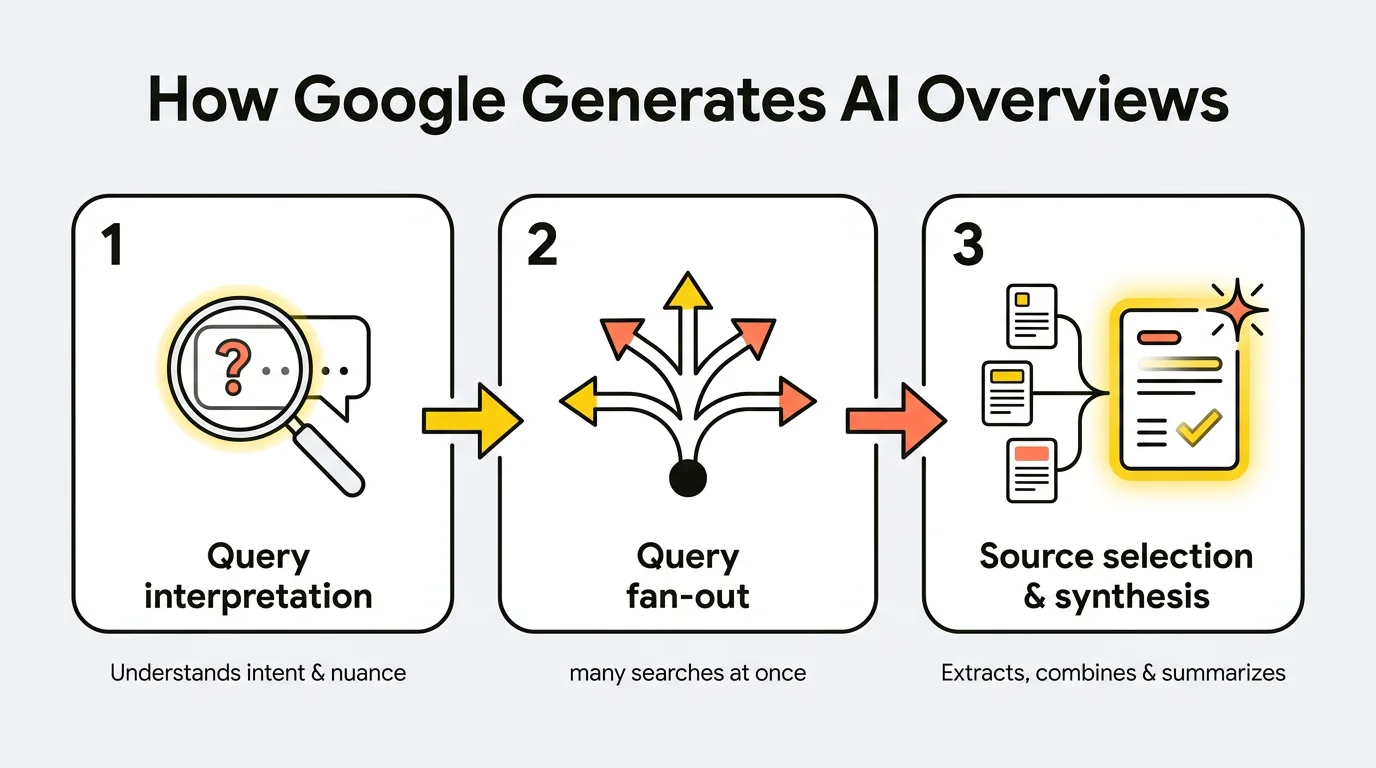
Google generates AI Overviews through grounding — basing the model’s answer on live search results and the search index rather than on training data alone. The Gemini model builds the answer from documents that Google’s Search systems consider valuable, not from memory. Simplified, the process looks like this:
- Query analysis. The system evaluates whether the query is a good candidate for a generated answer and which subtopics it touches.
- Query fan-out. Google officially confirms that AI Overviews and AI Mode may use a “query fan-out” technique — issuing multiple related searches across subtopics and data sources — which also surfaces a broader set of links than a classic results page (Google Search Central, 2025).
- Source selection. Generative features in Search are “rooted in our core Search ranking and quality systems” — the same systems that power the regular results (Google Search Central Blog, 2025).
- Answer synthesis. The model writes the summary and links the pages it drew on.
Two hard technical facts follow. First, to appear as a supporting link in AI Overviews or AI Mode, a page must be indexed and eligible to show in Google Search with a snippet — the standard nosnippet, data-nosnippet, max-snippet, and noindex controls all apply (Google Search Central, 2025). Second, no special file, markup, or structured data (schema.org) switches inclusion on — Google states there are no additional technical requirements beyond “helpful, reliable, people-first” content (Google Search Central Blog, 2025).
Which searches trigger AI Overviews?
AI Overviews appear on only a fraction of searches — historically the informational ones — and that fraction has swung several-fold within a single year. The clearest picture comes from Semrush’s analysis of more than 10 million keywords:
| Period | Share of queries with an AI Overview |
|---|---|
| January 2025 | 6.49% |
| July 2025 (peak) | 24.61% |
| November 2025 | 15.69% |
Source: Semrush AI Overviews Study, 2025. For comparison, Pew Research Center’s March 2025 study of real user behavior found an AI summary on 18% of observed searches (Pew Research Center, 2025).
The intent mix is shifting too: informational queries fell from 91.3% of AI Overview triggers in January 2025 to 57.1% in October 2025, while commercial queries grew to 18.57%, transactional to 13.94%, and navigational to 10.33% (Semrush, 2025). The practical takeaway: AI Overviews increasingly sit on product and purchase-adjacent queries — the ones businesses make money on.
How do AI Overviews affect organic traffic?
Independent studies agree on the direction: where an AI summary appears, clicks on traditional results drop sharply. The three most-cited datasets:
- Pew Research Center (900 US adults, 68,879 unique Google searches, March 2025): users clicked a traditional result on 8% of visits with an AI summary versus 15% without one — nearly half as often. A source link inside the summary itself was clicked on just 1% of such visits, and 26% of visits with an AI summary ended the entire browsing session, versus 16% without one (Pew Research Center, 2025). Google publicly disputed the study’s methodology.
- Ahrefs, first measurement (300,000 keywords, aggregated Google Search Console data, March 2024 vs March 2025): the presence of an AI Overview correlated with a 34.5% lower average click-through rate for the page ranking #1 (Ahrefs, 2025).
- Ahrefs, update (the same 300,000 keywords, December 2025 data): the correlation deepened to −58% for position #1 — “The presence of an AI Overview now correlates with a 58% lower average clickthrough rate for the top-ranking page” (Ahrefs, 2026).
Google disputes the direction. Liz Reid, Google’s Head of Search, wrote in August 2025 that total organic click volume from Google Search is “relatively stable year-over-year”, with traffic shifting between sites — but the post contains no supporting figures (Google, 2025). At launch in May 2024, Google likewise claimed that links inside AI Overviews get more clicks than traditional listings — again without published data (Google, 2024); set that against the 1% source-click rate Pew measured. Aggregate publisher data points the other way: across more than 2,500 publisher sites tracked by Chartbeat, traffic from Google organic search fell 33% globally between November 2024 and November 2025 — and 38% in the US (Reuters Institute, 2026).
How much traffic your keywords are losing (or gaining) to AI Overviews is exactly what we measure in an AI visibility audit — including which sources the models cite and the answer gaps your brand can claim.
How can you check whether your keywords trigger AI Overviews?
The only reliable method is checking the search results themselves — manually or with a rank-tracking tool — because Google Search Console does not report AI Overviews separately. Impressions and clicks from AI Overviews and AI Mode are folded into the overall performance report metrics (search type “Web”), with no dedicated filter or breakdown (Google Search Central, 2025).
A workable procedure:
- Export your queries from Search Console — start with the ones driving the most clicks and impressions.
- Check the SERPs manually — in incognito mode, with your target market’s location and language; note which queries show a summary and whether your domain is cited.
- Set up tool-based monitoring — major rank-tracking platforms (including Semrush and Ahrefs) flag AI Overview presence per keyword and track the cited domains at scale.
- Compare CTR over time — a click-through-rate drop at a stable position is the classic AI Overview footprint.
And remember the volatility: AI Overview coverage swung between 6.49% and 24.61% of queries within 2025 (Semrush, 2025) — a one-off audit goes stale fast, so monitoring has to be recurring.
What do AI Overviews mean for your brand?
AI Overviews split apart two things that classic SEO treated as one: your ranking position and your brand’s actual visibility. A strong position still helps a lot — 94% of AI Overviews cite at least one URL from the top 20, a page ranking #1 makes it into the summary in 43% of cases, and a page at #20 in 7% (seoClarity, 2025, 362,000 US queries). But the link is weakening: according to Ahrefs (863,000 keywords, 4 million cited URLs, March 2026), only 37.9% of AI Overview citations now come from the top 10, 31.2% from positions 11–100, and 31.0% from beyond the top 100 — versus 76.1% from the top 10 in July 2025 (Ahrefs, 2026). One caveat: part of that drop reflects a change in Ahrefs’ citation-detection methodology, not just Google’s behavior.
The second takeaway concerns the signals that build visibility. In an Ahrefs analysis of 75,000 brands, brand mentions across the web correlated with AI Overview visibility far more strongly (Spearman correlation of 0.664) than backlinks (0.218) or organic traffic (0.274) (Ahrefs, 2025). That is a correlation, not proof of causation — but the direction fits the logic of grounding: the model cites what the web’s corpus consistently associates with the topic.
The third takeaway: a citation (in an AI answer) does not guarantee that users ever see your brand. In a study by Semrush and Kevin Indig, 61.7% of citations in AI answers were ghost citations — the page is linked as a source, but the brand name never appears in the answer text (Semrush + Kevin Indig, 2026; a moderate sample — 115 prompts, 4 platforms — so treat it as an order of magnitude). That is why URL citations and brand mentions need to be tracked as separate KPIs.
AI Overviews do not kill the search engine — they kill the assumption that a top-10 ranking equals visibility. Since 2025, a brand can rank and be invisible, or not rank and get cited. Two different games, two different rulebooks.
The response to this shift is GEO (generative engine optimization) — creating and optimizing content so that it gets cited and used in AI-generated answers. You will find the complete playbook in our guide to GEO (generative engine optimization), and a breakdown of how this work differs from classic SEO in GEO vs SEO — what changes.
FAQ: common questions about AI Overviews
Do I need special markup or schema to appear in AI Overviews?
No. Google states directly that no new machine-readable files, AI text files, markup, or special schema.org structured data are required to appear in AI Overviews (Google Search Central, 2025). The conditions are that the page is indexed and snippet-eligible; the recommended path is “helpful, reliable, people-first” content (Google, 2025).
Can I block my site from appearing in AI Overviews?
Yes, with the standard snippet controls: nosnippet and data-nosnippet exclude content from the summaries, max-snippet caps how much can be quoted, and noindex removes the page from Search entirely (Google Search Central, 2025). Mind the cost: the same controls also limit your snippets in classic results — there is no opt-out for AI Overviews alone.
Where is Google’s AI Overview feature available?
AI Overviews serve over 2 billion monthly users in more than 200 countries and territories and 40 languages (Alphabet, Q2 2025). The feature launched for all US users on (Google, 2024) and reached nine European countries, including Poland, on (Search Engine Land, 2025).