
GEO and AEO are two names for nearly the same job: getting your content cited inside AI-generated answers instead of a ranked list of blue links. GEO stands for generative engine optimization; AEO stands for answer engine optimization. This article defines both, traces where each term came from, explains why we treat GEO as the umbrella label, and shows why the distinction some practitioners draw between the two does not hold up in practice.
What is the difference between GEO and AEO?
In practice there is no settled difference: GEO (generative engine optimization) and AEO (answer engine optimization) name the same discipline — structuring content and managing online presence so AI systems cite, summarize, and surface your information in their generated answers. That definition of GEO is the one in current reference use (Generative engine optimization, Wikipedia), and it describes AEO just as accurately.
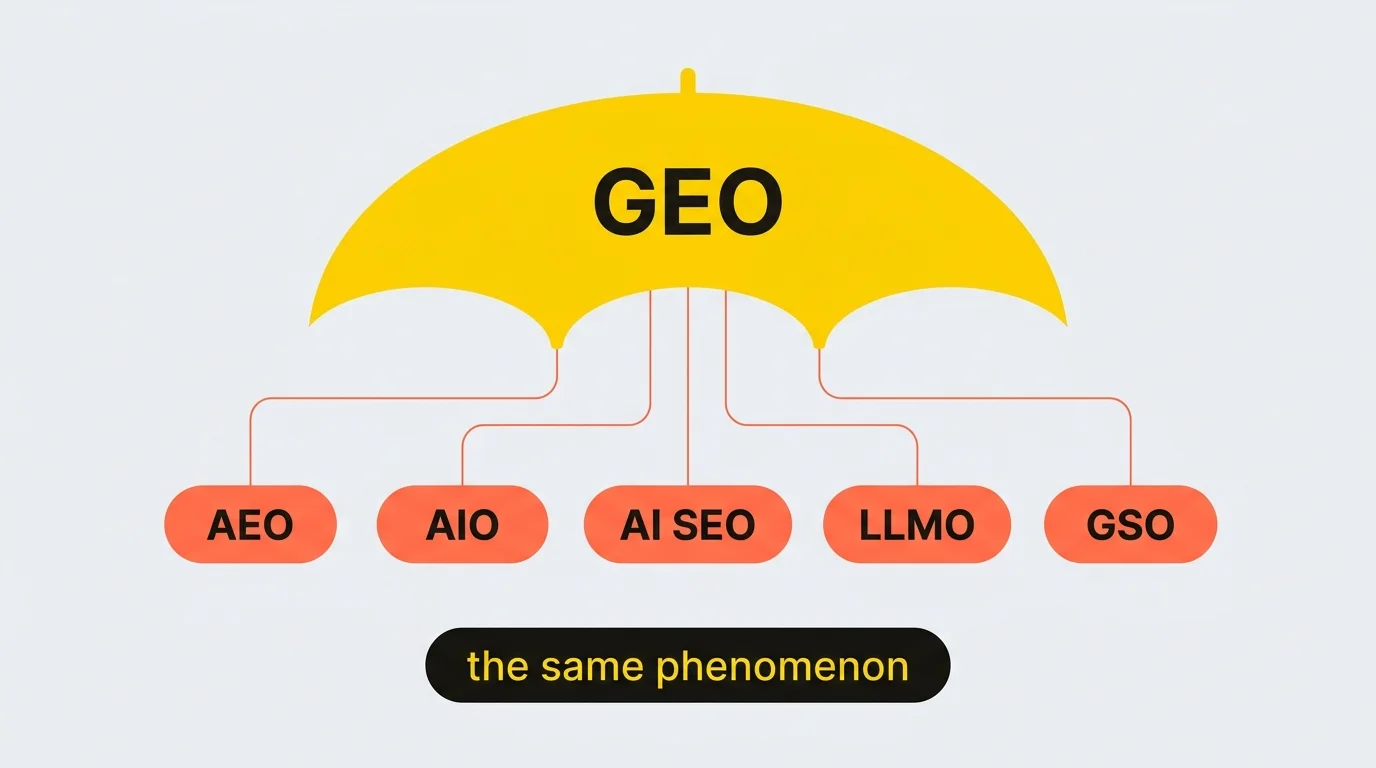
The academic literature backs this up. As of early 2026, no peer-reviewed work has established a definition that separates GEO from AEO, AIO, AI SEO, or LLMO — the terms are used interchangeably, and the same reference source explicitly lists AEO, AIO, AI SEO, and LLMO as related or interchangeable with GEO (Wikipedia, accessed July 2026). The industry has no shared taxonomy either: agencies, publishers, and marketers apply different acronyms — AEO, GEO, GSO — to the very same phenomenon, and they mean the same thing (Digiday, 2025).
Some practitioners do try to split the two — AEO for “answer engines” such as Google AI Overviews (the AI-generated summaries above Google’s results) and featured snippets, GEO for generative large language models and chatbots. That distinction is not standardized; in practice both terms target the same engines and the same goal (Digiday, 2025). A model like ChatGPT is both a “generative engine” and an “answer engine,” so the boundary was never clean to begin with.
Where do the terms GEO and AEO come from?
GEO comes from academia; AEO comes from practitioners — that origin gap is the clearest real difference between the two labels. GEO is the only one of the acronyms (GEO, AEO, AIO, AI SEO, LLMO) with a founding academic paper. The term was introduced in a peer-reviewed study by Aggarwal and colleagues (Princeton, the Allen Institute for AI, Georgia Tech, and IIT Delhi); the first arXiv version appeared on , and the paper was published at KDD 2024 (GEO: Generative Engine Optimization, Aggarwal, Murahari et al.).
GEO then spread beyond academia. A widely read essay from the venture fund Andreessen Horowitz, “GEO over SEO,” published , pushed the term into mainstream marketing conversation and promoted a “reference rate” — how often a model cites or draws on a brand — as the metric to watch instead of rankings and click-through rate (Andreessen Horowitz, 2025).
AEO took the opposite path. It has no single author and no founding paper; it emerged in practice across 2024–2025, alongside the arrival of Google AI Overviews, and its closest predecessor is the older craft of optimizing for featured snippets, or “position zero,” from around 2014 (Profound, accessed July 2026). The answer engine that did most to fuel AEO talk was AI Overviews itself, which began rolling out to everyone in the US on at Google I/O (Google, 2024).
| Term | Expansion | Origin |
|---|---|---|
| GEO | Generative engine optimization | Peer-reviewed research: Aggarwal et al., arXiv Nov 2023, KDD 2024 — the only acronym with an academic founding paper |
| AEO | Answer engine optimization | Practitioner term, 2024–2025; no founding paper; descends from featured-snippet optimization (~2014) |
| AIO / LLMO / AI SEO / GSO | AI optimization / LLM optimization / AI SEO / generative search optimization | Vendor and blog variants — used interchangeably with GEO and AEO |
Why do we treat GEO as the umbrella term?
We treat GEO as the umbrella term for one verifiable reason: it is the only label on the list with a peer-reviewed founding paper, which gives it a fixed, citable definition the others lack (Aggarwal et al., KDD 2024). Standardizing on a single name across an entire site is also a topical-authority decision — mixing GEO, AEO, and AIO at random weakens the semantic signal that a brand is a consistent source on the subject. Our entity glossary fixes GEO as the canonical term and treats AEO as a near-synonym.
The counterargument is real and worth stating. The analytics vendor Profound agrees that AEO and GEO share the same goal — “deliver content as a trusted answer when someone asks a question” — yet prefers the label AEO, partly because the acronym GEO collides with geography, geology, and geo-targeting (Profound, 2026). That collision is genuine: in everyday use “geo” means geolocation or geo-targeting, which is exactly why the acronym has to be expanded on first mention in an AI context (Profound, 2026). We handle the ambiguity with a rule rather than a different word — always write “GEO (generative engine optimization)” on first use — and keep the term consistent everywhere else.
Does the GEO-vs-AEO distinction matter for your strategy?
No — the label rarely changes what you actually do, because the underlying work is the same whichever acronym you pick. Google’s own position is that optimizing for generative search features is still SEO: there is no separate “GEO” or “AEO” process for AI Overviews or AI Mode, which run on the same ranking and quality systems as Search, with no extra technical requirements (Google Search Central, 2025). Whatever you call the work, the foundation — content quality, ranking, and authority — is shared.
The evidence on specific tactics is mixed, and that too is independent of the name. In the peer-reviewed GEO benchmark (Aggarwal et al., KDD 2024), the strongest tactics — adding quotations, statistics, and citations — produced up to roughly 40% relative improvement on the Position-Adjusted Word Count metric; an independent replication, C-SEO Bench (NeurIPS 2025), did not confirm that effect on its citation-ranking metric (C-SEO Bench vs the GEO paper). The practical takeaway holds regardless of terminology: write clear, sourced, quotable content because it raises quality and trust, not because one acronym promises a fixed uplift.
So the choice between “GEO vs AEO” is a naming decision, not a strategic one. Pick the term your audience searches for, expand it on first use, and spend your energy on the work both words describe. If you want the full method behind that work — technical access, index coverage, citable content, and measurement — it is laid out in our guide to GEO (generative engine optimization).
GEO and AEO are two names for the same shift: visibility stops being a ranking position and becomes presence inside a generated answer. We standardize on GEO because it is the only term with a peer-reviewed founding paper — but the decision that matters is picking one name, expanding it once, and measuring citations and brand mentions rather than arguing about the acronym.
The fastest way to see which term is academic is to see where you stand today: which AI answers already cite your brand, which your competitors own, and which are still open. That baseline is exactly what an AI visibility audit delivers — before you spend a single hour on GEO, AEO, or whatever you decide to call it.
FAQ: GEO vs AEO
Is AEO the same as GEO?
Yes — in dominant usage AEO (answer engine optimization) and GEO (generative engine optimization) are synonyms for optimizing content to be cited in AI-generated answers. As of early 2026 no peer-reviewed work defines a difference between them, and the terms are used interchangeably along with AIO, AI SEO, and LLMO (Wikipedia, 2026). Agencies apply AEO, GEO, and GSO to the same phenomenon (Digiday, 2025).
Which term should I use, GEO or AEO?
Use whichever your audience searches for, and stay consistent. We standardize on GEO because it is the only acronym with a peer-reviewed founding paper (Aggarwal et al., KDD 2024); vendors such as Profound prefer AEO because “GEO” collides with geo-targeting and geography (Profound, 2026). Either is defensible — just expand the acronym on first use and do not mix labels at random.
Is AEO just optimizing for featured snippets?
No, but that is where it comes from. Answer engine optimization has no founding paper; it emerged in practice across 2024–2025 with the rise of Google AI Overviews, and its closest predecessor is featured-snippet or “position zero” optimization from around 2014 (Profound, 2026). AEO now targets generative answers, not just the snippet box — but the lineage explains why some practitioners still frame it around “answer engines.”