
ChatGPT has reached 800 million weekly active users — Sam Altman announced the number at OpenAI DevDay in October 2025 (TechCrunch, 2025). Increasingly, it is a language model — not a page of blue links — that tells your customers what your brand is and whether to trust it. This guide explains, with zero math, what an LLM is, where it gets its “knowledge” of your company, and what that means for the content you publish.
What is an LLM in AI? The meaning, minus the math
An LLM (large language model) is an AI system that generates text by predicting the most probable next fragment of a sentence — it is the engine behind ChatGPT, Gemini, Claude, and similar tools. An LLM is not a database and not a search engine: it stores no web pages, only language patterns learned from enormous volumes of text. When you ask it anything, it does not “look up” an answer — it composes one, piece by piece, from those patterns.
The “large” in the name refers to parameters — the internal dials in which the model stores what it has learned. GPT-3, the model that started the current wave, had 175 billion parameters, ten times more than any previous non-sparse language model (Brown et al., GPT-3 paper, 2020). Parameter scale is the defining trait of a “large” language model: the more patterns a model holds, the more fluently it writes — and the more world knowledge it absorbs along the way.
For marketers, one consequence of that architecture matters most: an LLM will always produce a fluent answer, including when it has no facts to base it on. LLMs also power generative engines — systems that answer with a generated response instead of a list of links (ChatGPT, Perplexity, Google AI Overviews, Copilot). Those answers are where your brand is now named, cited — or left out.
Training vs. grounding: why an LLM knows your brand — or doesn’t
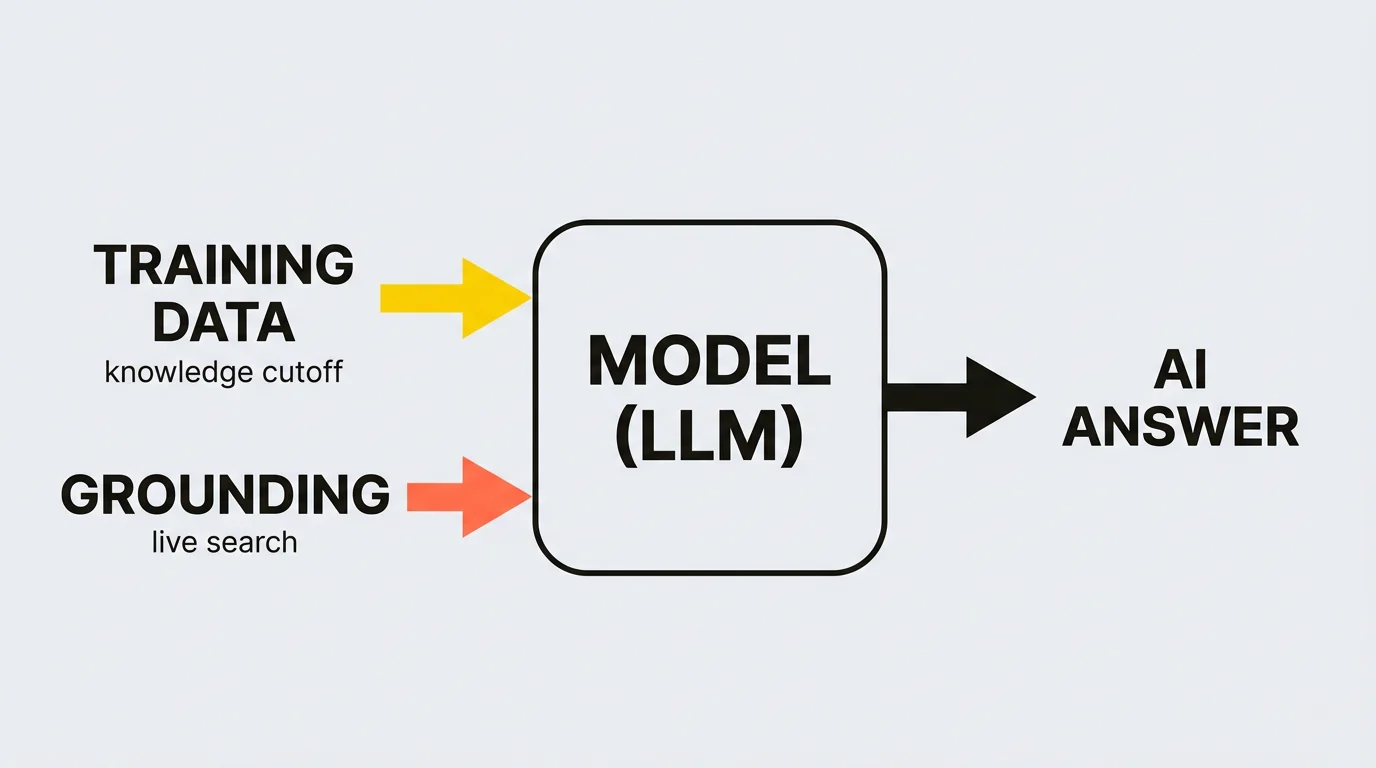
An LLM gets its knowledge of your brand from exactly two separate sources: training data (knowledge frozen in time) or grounding (live retrieval while the answer is being generated). That split is the single most useful thing a marketer can learn about these systems.
Training happens once, on text collected up to a specific date — the knowledge cutoff. For example, the Gemini 3 model family has a knowledge cutoff of January 2025: the model knows nothing that happened later unless it reaches for search (Google AI for Developers, as of July 2026). If your brand appeared rarely on the web before that date — or launched after it — the model simply does not “remember” you, and when asked, it may confuse you with someone else or invent details.
Grounding means basing model answers on live search results or an index rather than training data alone. Per Google’s documentation, grounding “connects the Gemini model to real-time web content”, reduces hallucinations by basing responses on real-world information, adds source citations, and lets the model answer questions beyond its knowledge cutoff (Google, Grounding with Google Search, as of July 2026). In practice: ChatGPT search grounds its answers partly on the Bing index and partly on OpenAI’s own index built by the OAI-SearchBot crawler, while Microsoft Copilot is officially grounded by Bing — it only sees pages indexed in Bing (OpenAI Help, ChatGPT search, as of July 2026). The two pipelines are so distinct that OpenAI gives site owners separate controls: blocking GPTBot removes your content from model training, while blocking OAI-SearchBot removes it from ChatGPT search answers — you can opt out of one and stay in the other (OpenAI Bots documentation, as of July 2026).
From a brand’s perspective, that leaves three scenarios:
- Your brand is in the training data — the model answers “from memory”: broadly, but frozen at the knowledge cutoff and with no guarantee the details are right.
- Your brand is in the search indexes (Bing, Google, the engines’ own indexes) — grounding can fetch your content live and cite it as a source.
- Your brand is in neither — the model stays silent about you or guesses. To a generative engine, that brand does not exist.
Tokens and context windows in plain English
A token is the basic unit in which an LLM reads and writes text — a fragment of a word, a whole word, or a punctuation mark. Per OpenAI’s official documentation, “as a rough rule of thumb, 1 token is approximately 4 characters or 0.75 words for English text” — so 100 tokens is roughly 75 words (OpenAI API documentation, as of July 2026). Usage limits, API pricing, and how much text a model can process at once are all counted in tokens.
The context window is the model’s working memory: the maximum amount of text it can see at one time — your question, attached documents, search results pulled in by grounding, and the conversation so far. Gemini 3 Pro accepts 1 million tokens of input (and up to 64,000 tokens of output); per Google’s documentation, 1 million tokens fits roughly 8 average-length English novels, transcripts of over 200 podcast episodes, or 50,000 lines of code (Google, Long context, as of July 2026). A big window does not mean equal attention, though: the peer-reviewed “Lost in the Middle” study found a U-shaped curve — models use information from the beginning and end of the context best, and significantly worse from the middle of a long context (Liu et al., TACL, 2024). The content takeaway: put your most important facts and answers at the top of the page and at the top of each section.
Why do LLMs hallucinate — and why sourced facts win?
LLMs hallucinate — state made-up information with full confidence — because their training rewards fluent guessing over admitting uncertainty. A paper by OpenAI researchers argues that hallucinations originate as natural classification errors during pretraining and persist because standard training and evaluation procedures “reward guessing over acknowledging uncertainty” — benchmarks score a lucky guess higher than “I don’t know” (Kalai et al., OpenAI, 2025).
The scale of the problem is measurable:
| Study | Result | Conditions |
|---|---|---|
| Stanford — Dahl et al., Journal of Legal Analysis, 2024 | hallucination rates: GPT-4 58%, GPT-3.5 69%, Llama 2 88% | 800,000+ verifiable legal questions; 2023-generation models, no grounding |
| NewsGuard one-year AI audit, 2025 | 35% of answers repeated a false claim (vs. 18% a year earlier) | 10 leading chatbots (incl. ChatGPT, Gemini, Claude, Copilot, Perplexity); news topics |
The NewsGuard audit also shows the flip side of grounding: after real-time search was rolled out, the chatbots’ refusal rate dropped from 31% to 0% (NewsGuard, 2025). A model connected to the web always answers — and the quality of that answer depends on the quality of the sources it retrieves. If the index only holds vague, undated content on your topic, the model works with weak material; if it finds unambiguous facts with a number, a date, and a named source, it has something safe to cite and build on. Google’s documentation explicitly lists citing verifiable sources as a function of grounding (Google, as of July 2026).
A language model does not distinguish true from false — it distinguishes content that is safe to cite from content that isn’t. A brand that publishes unambiguous facts with a number, a date, and a source lowers the model’s cost of citing it — and beats the brand that writes in generalities.
What LLM mechanics mean for your brand’s content
The practical conclusion: since training is frozen and grounding runs live, your brand’s visibility in AI answers today is decided by content that is accessible to crawlers, unambiguous, and backed by sources. That is exactly the job of GEO (generative engine optimization) — creating and optimizing content so that it gets cited and used in AI-generated answers. The way LLMs work translates into five concrete priorities:
- Answer first. Models use information from the beginning of the context best (Liu et al., 2024), so the first sentence of every section should carry the answer, not a warm-up.
- State facts with a number, a date, and a source. In a peer-reviewed GEO experiment, adding statistics, quotations, and source citations raised content visibility in generative answers by up to roughly 40% in relative terms on the benchmark metric, while keyword stuffing hurt it (Aggarwal et al., KDD 2024); an independent replication did not confirm the effect (C-SEO Bench, NeurIPS 2025) — so treat precise, sourced facts as a credibility standard, not a guaranteed “+40% trick”.
- Get indexed — including in Bing. Copilot only sees pages indexed in Bing, and ChatGPT search relies partly on the Bing index (OpenAI Help, as of July 2026). Keep critical content in plain HTML, too: none of the major AI crawlers currently render JavaScript, so client-side-only content is invisible to them (Vercel and MERJ, 2024).
- Build mentions beyond your own site. About 84% of citations in AI answers come from earned media — third-party sources, not brands’ own content (Muck Rack, 2026; sample of 25M+ links).
- Keep content fresh. AI assistants cite content that is on average 25.7% fresher than Google’s organic results (Ahrefs, 2025; sample of 16.975M URLs) — and facts without a time anchor age into misinformation.
How these principles add up to a complete strategy is covered step by step in our guide to GEO (generative engine optimization), and how the discipline differs from classic search optimization in GEO vs SEO: what changes.
Not sure whether ChatGPT, Gemini, and Perplexity know your brand at all — or what they say about it? That is exactly what an AI visibility audit measures: book a free consultation and we will check which AI answers your company shows up in.
Glossary: 8 terms every marketer should know
These eight terms cover most conversations about brand visibility in AI answers — enough to brief a team or challenge an agency.
- GEO (generative engine optimization) — creating and optimizing content so that it gets cited and used in AI-generated answers.
- Generative engine — a system that answers with a generated response instead of a list of links (ChatGPT, Perplexity, Google AI Overviews, Copilot).
- Grounding — basing model answers on live search results/an index rather than training data alone.
- Citation (in an AI answer) — a link/reference to a page as a source within a generative answer.
- Brand mention — the brand name appearing in the AI answer text, regardless of citation.
- Ghost citation — a URL cited as a source without the brand being named in the answer text.
- AI share of voice — the share of AI answers to a defined prompt set in which the brand appears.
- Topical authority — complete, interlinked coverage of a topic that makes a site a reference source.
FAQ: common questions about LLMs
Is an LLM the same thing as a search engine?
No. A search engine finds and ranks existing pages; an LLM generates new text from patterns learned in training. Generative engines combine both mechanisms through grounding: they first retrieve content from an index (ChatGPT search uses the Bing index among others — OpenAI Help, as of July 2026), then the model writes an answer based on it.
Why doesn’t ChatGPT know my brand?
Usually for one of three reasons: your brand appeared too rarely in the training data, it launched after the model’s knowledge cutoff (January 2025 for Gemini 3 — Google documentation, as of July 2026), or your site is not indexed where grounding looks. The first step is checking your indexing in Bing and Google and counting brand mentions in independent sources.
Do LLMs cite the sources of their answers?
Only when grounding is on — then the engine adds citations to the pages it used (Google documentation, as of July 2026). Note that a citation is not a brand mention: per the Semrush and Kevin Indig study, 61.7% of citations in AI answers are ghost citations — the page URL is listed as a source, but the brand never appears in the answer text (Semrush, 2026).