How to use this GEO glossary
This GEO glossary collects 30 terms that map the whole field of brand visibility in AI-generated answers — from the definition of GEO itself to the technical details of crawler access. Every entry has a concise definition, and wherever hard data exists we give the number with its source. This is a reference text: our other articles link their concepts back here, and the full context of the method lives in our guide to GEO (generative engine optimization). Knowledge current as of .
We grouped the terms into five thematic blocks so the definitions build on each other rather than sitting in alphabetical chaos. We start with the umbrella terms, move through the mechanism that generates answers, and finish with measurement and technical hygiene.
Core terms: GEO, AEO and the generative engine
The foundation of any GEO glossary is the four umbrella terms that name the discipline and its environment. Without them, the rest of the vocabulary floats free.
GEO (generative engine optimization)
Creating and optimizing content so that it gets cited and used in AI-generated answers. The term comes from a peer-reviewed paper by Aggarwal et al. presented at the KDD 2024 conference, which introduced the GEO-bench benchmark (10,000 queries) and reported visibility gains in generative answers of up to 40% on that benchmark metric (GEO: Generative Engine Optimization, KDD 2024). Do not confuse it with geolocation or geo-targeting — which is why we always expand the acronym on first use.
AEO (answer engine optimization)
A near-synonym of GEO used by part of the industry, emphasizing optimization for “answer engines.” We treat GEO as the umbrella term and AEO as a naming variant; we unpack the overlap and the differences in GEO vs AEO.
AI SEO
A loose label for the whole body of SEO work adapted to the AI search era. It is sometimes used interchangeably with GEO, but it is broader and less precise — it still covers classic SEO, which continues to feed the indexes that grounding draws on.
Generative engine
A system that answers with a generated response instead of a list of links. ChatGPT, Perplexity, Google AI Overviews and Copilot all belong to this category. It is the environment in which GEO plays out.
Large language model (LLM)
A large language model — an AI system that generates text and powers ChatGPT, Gemini, Claude and similar tools. An LLM produces its answer word by word from patterns learned in training, and in search mode also from retrieved sources. More in what an LLM is for marketers.
How generative engines build answers
Generative engines rarely answer from the model’s memory alone — they usually attach fresh sources from search to the query. These terms describe that mechanism and the surfaces it produces.
RAG (retrieval-augmented generation)
An architecture that pairs a generative model with an external retrieval system: the model first fetches matching documents, then generates its answer from them. The term was introduced by Lewis et al. (Meta AI) at the NeurIPS 2020 conference (Retrieval-Augmented Generation for Knowledge-Intensive NLP Tasks, 2020). RAG is the technical foundation of today’s AI search.
Grounding
Basing a model’s answer on live search results or an index rather than on training data alone. Grounding is the practical implementation of RAG inside a product — it decides which pages even reach the “context” the model builds its answer from. Expanded in where ChatGPT gets its information.
AI Overviews
AI-generated summaries shown above Google’s search results. They launched in the US on 14 May 2024 as a rebrand of the earlier Search Generative Experience (Google, May 2024). AI Overviews routinely cite pages outside Google’s top ten — the share of citations from the top 10 fell from 76.1% in July 2025 to 37.9% in March 2026 (Ahrefs, March 2026). More in what AI Overviews are.
AI Mode
A separate, conversational search mode from Google in which the user holds a dialogue with the system instead of scanning a list of links. Unlike AI Overviews, it is a distinct surface rather than a module sitting above the normal SERP.
Hallucination
A model generating false or fabricated information stated with apparent confidence. Grounding reduces hallucinations by tying the answer to real sources, but it does not eliminate them — which is exactly why unambiguous, verifiable content matters so much in GEO.
Citation, brand mention and ghost citation — how they differ
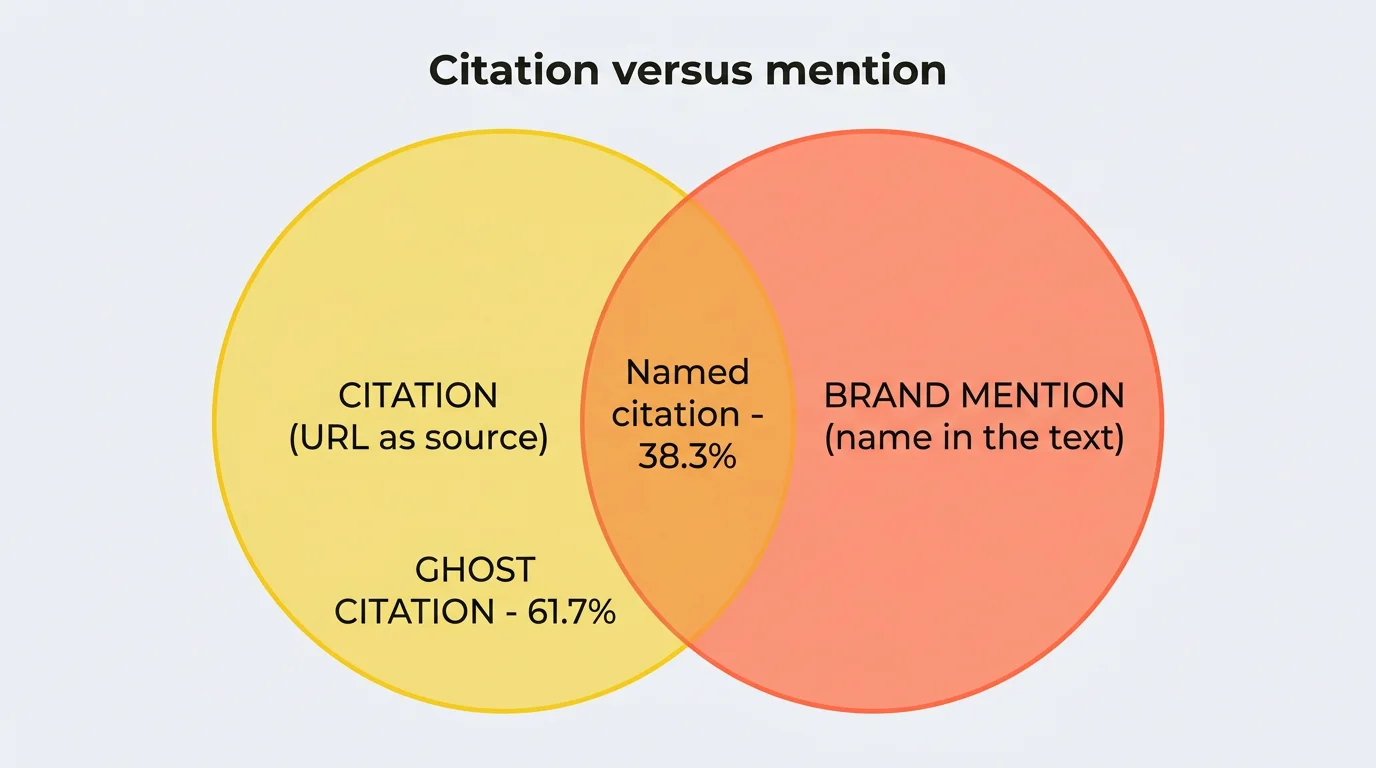
Being the source of an answer and being named in its text are two separate events, and confusing them is the most common measurement error in GEO. These terms keep them apart precisely.
Citation (in an AI answer)
A link or reference to a page as a source within a generative answer. A citation means your content fed the answer, but it does not guarantee that the reader will see your brand name. More on how sources get picked: how ChatGPT picks sources.
Brand mention
The brand name appearing in the AI answer text, regardless of whether the page is linked. Branded web mentions correlate with AI visibility far more strongly than backlinks or Domain Rating: 0.656–0.709 for mentions against 0.218 for backlinks (Spearman correlation, not causation) (Ahrefs, December 2025, 75,000 brands).
Ghost citation
A URL cited as a source without the brand being named in the answer text. In a Semrush study, ghost citations accounted for 61.7% of all citations, while only 38.3% came with a brand mention (Semrush and Kevin Indig, June 2026). We break the phenomenon down in our piece on ghost citations.
AI share of voice
The share of AI answers to a defined set of questions in which your brand appears. It measures visibility relative to competitors across a repeatable prompt set. How to calculate it is covered in share of voice in AI.
Earned media
Mentions and coverage in third-party sources a brand does not pay for directly — articles, reviews, rankings, community threads. Generative engines cite these above all: roughly 84% of AI citations come from earned media, while paid content accounts for just 0.3% (Muck Rack, May 2026, over 25M links). The role of this channel: earned media and AI citations.
Citation magnet
A content element that raises the odds of being cited: a number with a source, an expert quote, a reference, unique first-party data. In the GEO-bench experiment the most effective were Quotation Addition, Statistics Addition and Cite Sources — a relative 30–40% lift on the PAWC metric, from a baseline of 19.5 to 27.8, 25.9 and 24.9 respectively (GEO, full text v3, 2024). First-party data is the strongest magnet, because nobody else has it.
Which content and authority signals count in GEO?
Generative engines judge not a single page but the consistency and credibility of the whole corpus around a brand. These terms describe the signals that drive it.
Entity
An unambiguously identified object — a brand, person, product or place — recognized by AI systems independently of any single keyword. A consistent, repeatable definition of an entity across your site and beyond builds its recognizability. In practice: entities and brand semantic consistency.
Topical authority
Complete, interconnected coverage of a topic that makes a site be treated as a reference source in its field. It is built by a network of mutually linking content around one area, not by a single article. This glossary is one node in such a network.
E-E-A-T
Experience, Expertise, Authoritativeness and Trust — Google’s framework for assessing content quality. Google added the second “E” (Experience) to the earlier E-A-T in December 2022 in its Search Quality Rater Guidelines (Google Search Central, December 2022). How it maps onto GEO: E-E-A-T for AI.
Knowledge graph
A network of entities and the relationships between them, on which search systems base their understanding of the world. Statements written as clear subject–predicate–object triples (“Vistrix Labs is a GEO agency”) slot into a knowledge graph more easily than sentences full of pronouns and metaphor.
Citable statement
A sentence built to stay true and complete when pulled out of context: a named subject, a number and a source. The test: pasted into a ChatGPT answer, is it true, complete and attributable to your brand? The craft: how to write for AI citations.
Freshness
Content recency as a source-selection signal. AI assistants cite content that is meaningfully fresher than organic Google — a median of 1,064 days versus 1,432 days, or 25.7% fresher — with the exception of AI Overviews, where citation age is close to the regular SERP (Ahrefs, July 2025). We refresh for factual accuracy, not as a trick.
BLUF (Bottom Line Up Front)
An editorial rule: the key claim and number go at the very start — of the text, the section and the paragraph. It is the inverted pyramid applied consistently, so a model can find a self-contained fragment to cite without reading the whole thing.
Which technical and measurement terms must you know?
The best content never appears in an AI answer if the bot cannot fetch it or cannot understand it. The final block collects the terms at the edge of engineering, measurement and myth that are worth knowing so you do not waste budget.
Structured data (schema.org)
Machine-readable content markup (e.g. JSON-LD). It is technical hygiene, not a citation lever: cited pages carry JSON-LD about 3x more often, but a quasi-experiment found no causal increase in citations after adding schema (Ahrefs, May 2026). Google confirms that no special schema is needed to appear in AI Overviews or AI Mode (Google Search Central, December 2025). The facts: schema and GEO.
llms.txt
A proposed standard for a file mapping a site’s most important content for AI systems. Status: a proposal without confirmed adoption — of roughly 38,000 domains with a valid file, 97% received zero requests for it in May 2026, and no major LLM provider uses it (Ahrefs, June 2026). A cheap, zero-cost bet: how to implement llms.txt.
robots.txt (for AI bots)
The file that controls crawler access to a site. In GEO you need to let AI bots through, but the rules can be ambiguous: in December 2025 OpenAI removed its statement that ChatGPT-User respects robots.txt, because “actions are initiated by a user, robots.txt rules may not apply” (OpenAI, December 2025). Configuration: robots.txt for AI crawlers.
AI crawler
An automated agent that fetches content for AI systems. OpenAI separates three roles: GPTBot (training), OAI-SearchBot (the ChatGPT search index) and ChatGPT-User (on-demand fetch triggered by a user) (OpenAI, December 2025). Add ClaudeBot, PerplexityBot, Google-Extended and bingbot, among others — each has to be handled deliberately.
Client-side rendering (CSR)
Building a page’s content in the user’s browser with JavaScript instead of serving ready HTML. It is a trap for AI bots: the main crawlers such as GPTBot and ClaudeBot fetch JS files but do not execute them, so content rendered purely client-side is invisible to them (Vercel and MERJ, December 2024). More broadly: JavaScript and AI crawlers.
Keyword stuffing
Artificially cramming keywords into content. It does not work in generative engines — it hurts visibility: 17.8 against a 19.5 baseline on the PAWC metric in GEO-bench, about 9% down (GEO, full text v3, 2024). The opposite of what GEO rewards.
GEO-bench and PAWC
GEO-bench is a benchmark of 10,000 queries used to measure the effectiveness of GEO tactics; PAWC (Position-Adjusted Word Count) is its main answer-visibility metric. Be careful about repeating “+40%” as a fact: an independent replication (C-SEO Bench, NeurIPS 2025) did not confirm the lift — a significant positive effect appeared in only 3 of 54 cases, and the Statistics tactic worsened ranking in 19 of 24 settings (C-SEO Bench, NeurIPS 2025). The full comparison: the GEO paper vs its replication.
A GEO glossary is not decoration — it is infrastructure. When one entity has one name and one definition across your entire site, a language model stops guessing what you mean and starts citing you as a reference source.
If you want to see which of these AI search terms actually move your brand’s visibility — and where AI already cites you versus where it skips you — that is exactly what we measure in the Vistrix Labs AI visibility audit: brand mentions and URL citations tracked separately, per engine.
FAQ
What is the difference between GEO and SEO?
SEO optimizes content for a position on a list of links in a search engine; GEO (generative engine optimization) optimizes for being cited and used in a generative engine’s ready-made answer. They partly overlap, because search indexes feed grounding, but they have different success metrics: position and click versus citation and brand mention. The full comparison is in GEO vs SEO.
Which term in this glossary matters most to start with?
The split between a citation and a brand mention, because it decides whether your measurement is correct. A citation is a link to your page as a source; a mention is your brand name in the answer text. In a Semrush study, 61.7% of AI citations were ghost citations — a link with no brand name in the text (Semrush and Kevin Indig, June 2026). Without that split, every AI visibility dashboard misleads.