AI SEO is the label marketers reach for when they notice that ChatGPT, Perplexity, and Google’s AI Overviews answer questions before anyone clicks a link. The discipline is real; the name is not settled — the same work is called GEO, AEO, LLMO, or AIO depending on the author. This article defines AI SEO, sorts out the competing acronyms (and why we treat GEO as the canonical term), and lists what the work actually involves in practice.
What is AI SEO?
AI SEO — long form: AI search engine optimization — is the practice of optimizing a website and its content so that AI systems such as ChatGPT, Perplexity, Microsoft Copilot, and Google AI Overviews cite your pages as sources and mention your brand in their generated answers. In dominant usage it is a synonym of GEO (generative engine optimization) and AEO (answer engine optimization). The object of optimization is no longer a position on a results page but presence inside the output of a generative engine — a system that responds with a generated answer instead of a list of links.
The term carries one trap. “AI SEO” (and its inverted twin “SEO AI”) also has a second, unrelated meaning: using AI tools to automate classic SEO work — keyword clustering, content briefs, internal linking, meta tags. That is process automation inside the old channel, not a new channel. When a vendor or an article says “AI SEO,” check which of the two meanings is on the table; this article covers the first one — visibility in AI-generated answers.
The discipline exists because the audience moved. ChatGPT passed 800 million weekly active users, per Sam Altman’s announcement at OpenAI DevDay (TechCrunch, 2025). Google’s AI Overviews reach 2 billion monthly users across 200 countries, and AI Mode passed 100 million monthly active users in the US and India, per Alphabet’s Q2 2025 earnings call (TechCrunch, 2025). EMARKETER forecasts that 31.3% of the US population will use generative-AI-powered search in 2026 (EMARKETER, 2026).
AI SEO, GEO, AEO, LLMO: five names for one discipline
The industry has not agreed on a single name for this work — AI SEO is one entry in a crowded field of synonyms. An eMarketer analysis counts five competing acronyms in parallel use — GEO, AEO, GSO, LLMO, and AIO — and finds that only 59% of SEO influencers consistently refer to the term GEO, while fewer than one in three kept their terminology consistent through 2025 (eMarketer, 2026; treat the percentages as an order of magnitude — the published methodology is brief).
| Term | Expansion | Where it comes from |
|---|---|---|
| AI SEO / SEO AI | AI search engine optimization | Colloquial umbrella label; also (confusingly) used for “doing SEO with AI tools” |
| GEO | Generative engine optimization | Peer-reviewed research (KDD 2024) — the only term with an academic origin and a benchmark |
| AEO | Answer engine optimization | Industry usage; the “answer engine” framing predates generative engines (featured snippets, voice assistants) |
| LLMO / AIO / GSO | LLM optimization / AI optimization / generative search optimization | Vendor and blog variants of the same idea |
| C-SEO | Conversational SEO | Academic replication research (NeurIPS 2025) |
We standardize on GEO for a verifiable reason: it is the only term on that list with a peer-reviewed origin. The paper “GEO: Generative Engine Optimization” (Aggarwal, Murahari et al., published at KDD 2024; first arXiv version ) introduced both the term and GEO-bench — a benchmark of 10,000 queries for measuring visibility in generated answers (Aggarwal et al., KDD 2024). Even academia is split, though: the independent replication study uses yet another synonym, “conversational SEO” (C-SEO Bench, NeurIPS 2025).
Google has entered the naming debate with its own position. Google’s official guide to optimizing for generative AI features names both acronyms — AEO and GEO — and concludes: “From Google Search’s perspective, optimizing for generative AI search is optimizing for the search experience, and thus still SEO” (Google Search Central, updated June 2026). Whatever you call it, the techniques, measurement, and tooling are the same — we cover them end to end in our guide to GEO (generative engine optimization).
How does AI SEO differ from classic SEO?
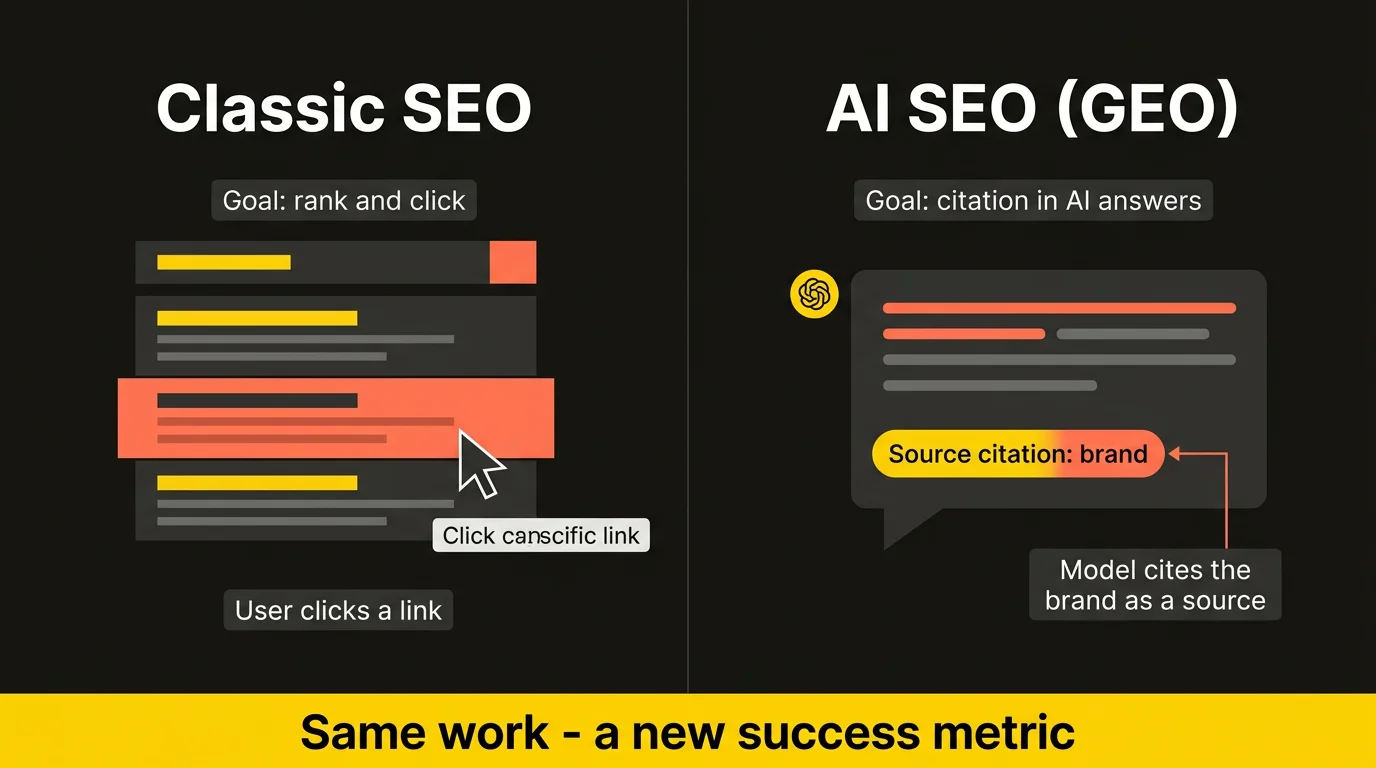
The unit of success changes: classic SEO optimizes for ranking positions and clicks, while AI SEO (GEO) optimizes for citations and brand mentions inside generated answers — and the two only partially overlap. In an Ahrefs study of 15,000 long-tail queries, only 12% of the links cited by ChatGPT, Gemini, and Copilot came from Google’s top 10, and about 80% of cited pages did not rank anywhere in Google’s top 100 for the query (Ahrefs, 2025; long-tail queries — for head terms the overlap may be higher). Ranking well remains useful; it is no longer sufficient.
The signals differ too. Across 75,000 brands, branded web mentions correlated with brand visibility in AI answers at 0.656–0.709 (Spearman), while backlinks — the classic SEO currency — correlated at just 0.218 (Ahrefs, 2025). These are correlations, not proof of causation, but the gap is hard to ignore. A full breakdown of what changes between the two disciplines — planning unit, success metric, content format — is in GEO vs SEO — what changes.
AI SEO, GEO, and AEO name the same shift: visibility stops being a ranking position and becomes presence in a generated answer. Pick one term and stick to it — but measure citations and brand mentions, or you are not doing the discipline, only saying its name.
What does AI SEO cover in practice?
In practice, AI SEO covers five work streams: technical access for AI crawlers, index coverage beyond Google, citable content, brand presence in third-party sources, and measurement. Concretely:
- Technical access for AI crawlers. None of the major AI crawlers render JavaScript — content that exists only after client-side rendering is invisible to them, a finding from server-log research covering, among others, 569 million GPTBot requests per month (Vercel + MERJ, 2024). Critical content belongs in server-rendered HTML.
- Index coverage beyond Google. Microsoft officially confirms that Microsoft Copilot grounds its answers through Bing Search — grounding means basing model answers on a live index rather than training data alone — so only Bing-indexed pages can be cited (Microsoft Learn, accessed July 2026). Bing Webmaster Tools stops being optional.
- Citable content, not exotic markup. Google states you do not need new machine-readable files, “AI text files,” or any special schema.org structured data to appear in AI Overviews or AI Mode (Google Search Central, 2025). What the research tested instead is content itself: in the GEO-bench experiment, adding quotations, statistics, and source citations improved visibility in generated answers by up to 40% on the Position-Adjusted Word Count metric (Aggarwal et al., KDD 2024). Treat that number with care: an independent replication on 1,900+ queries and four models found a statistically significant positive effect in only 3 of 54 tested cases, with the document’s position in the context — classic SEO territory — dominating citation odds (C-SEO Bench, NeurIPS 2025). The evidence for content-tactic uplift is mixed; the case for clear, sourced, quotable writing does not depend on one benchmark.
- Brand presence in third-party sources. About 84% of citations in AI answers from ChatGPT, Claude, and Gemini point to earned media — third-party sources, not brand-owned content (Muck Rack, 2026, 25M+ links analyzed). Digital PR and independent mentions are part of the job description.
- Measurement. AI share of voice — the share of AI answers to a defined prompt set in which the brand appears — tracked per engine and per month, with URL citations counted separately from brand mentions in the answer text.
That last stream is where the work usually starts: before optimizing anything, establish what the engines say about your brand today. That baseline — which answers you appear in, which competitors own, and which are up for grabs — is exactly what an AI visibility audit delivers.
What AI SEO is not
AI SEO is not old keyword tricks re-aimed at chatbots — measured head-on, keyword stuffing makes generative visibility worse. In GEO-bench it scored roughly −9% versus baseline on the PAWC metric, and about −10% on production Perplexity.ai (Aggarwal et al., 2024; independently corroborated in C-SEO Bench). Anyone selling “AI SEO” as keyword density for robots is selling a tactic the data says backfires.
It is not a replacement for SEO either. Generative engines are built on top of search indexes: Copilot, for one, can only cite what Bing has indexed (Microsoft Learn, accessed July 2026). A page that is not crawlable and indexable is invisible to both games at once — which is precisely why Google can plausibly claim that optimizing for generative AI is “still SEO.”
FAQ: AI SEO, GEO, and AEO
Is AI SEO the same as GEO and AEO?
Yes — in dominant usage AI SEO, GEO, and AEO are synonyms for optimizing content to be cited in AI-generated answers. The industry runs at least five acronyms in parallel (GEO, AEO, GSO, LLMO, AIO — eMarketer, 2026). We use GEO as the canonical term because it is the only one with a peer-reviewed origin (KDD 2024). Watch for the second meaning of “AI SEO”: using AI tools to automate classic SEO tasks.
Does AI SEO replace traditional SEO?
No. Generative engines sit on top of search indexes — Copilot can only cite Bing-indexed pages (Microsoft Learn, 2026), and Google states that optimizing for generative AI search is “still SEO” (Google Search Central, 2026). SEO remains the foundation; AI SEO extends it, because rankings alone no longer guarantee citations — only 12% of chatbot-cited links come from Google’s top 10 (Ahrefs, 2025).
Do I need special AI files or schema for AI SEO?
Not for Google — its documentation says no new machine-readable files, AI text files, or special schema.org structured data are needed to appear in AI features (Google Search Central, 2025). The binding technical requirement is more basic: major AI crawlers do not render JavaScript, so critical content must be present in server-rendered HTML (Vercel + MERJ, 2024).