
E-E-A-T (Experience, Expertise, Authoritativeness, Trust) is Google’s framework for assessing content quality — not a direct ranking factor. In AI search it works indirectly: Google’s generative features are built on the same core ranking and quality systems as Search (Google Search Central, May 21, 2025). This guide shows how to build author pages, bios with sameAs, and Person schema — and honestly separates what Google confirms from marketing multipliers with no source. Reviewed as of .
What is E-E-A-T, and is it a ranking factor?
E-E-A-T is Google’s framework for assessing content quality, not a direct ranking factor — the Quality Rater Guidelines exist to evaluate search systems, and rater scores do not feed directly into rankings (Google Search Central, December 15, 2022). That distinction is the foundation of an honest conversation about E-E-A-T: you build trust signals because they improve quality and credibility, not because there is an “E-E-A-T slider” that lifts your position.
The acronym has had four letters since December 2022, when Google added a second “E” — Experience — to E-A-T, creating E-E-A-T: Experience, Expertise, Authoritativeness, and Trust (Google Search Central, December 15, 2022). Inside that framework, Trust is the most important member: an untrustworthy page has low E-E-A-T regardless of the other elements, because — quoting the Guidelines (p. 27) — “Trust is the most important member of the E-E-A-T family” (Google Search Central, December 15, 2022). Experience, expertise, and authoritativeness are, in practice, evidence in service of trust — and the author of a piece is the main carrier of that evidence.
Does E-E-A-T matter in generative engines?
Yes, but indirectly — through the same Search quality systems that AI features are built on. A generative engine (a system that answers with a generated response instead of a list of links: ChatGPT, Perplexity, AI Overviews, Copilot) in Google’s implementation runs on that same core: “Our generative AI features… are rooted in our core Search ranking and quality systems,” and the path to visibility is helpful, reliable, people-first content — with “no additional technical requirements” (Google Search Central, May 21, 2025).
The practical takeaway: there is no separate “E-E-A-T optimization for AI” divorced from content quality. The same work that builds credibility with a reader and a quality rater is what Google tells you to do for generative features. How these signals fit into a wider AI visibility strategy is something we lay out in our complete guide to generative engine optimization — the practice of creating content so that it gets cited and used in AI-generated answers.
How do you build the author page and bio Google expects?
Start with self-evident authorship: in its people-first guidance, Google tells you to ask “Who” — is it obvious who wrote the content, do pages carry a byline, and does that byline lead to information about the author and the areas they write about (Google Search Central, 2025). This is not a cosmetic suggestion — it is one of the self-assessment questions Google tells you to measure your own content against.
The second self-assessment question is about competence: is the content written or reviewed by “an expert or enthusiast who demonstrably knows the topic well” (Google Search Central, 2025). A real expert author satisfies both conditions at once; anonymous content satisfies neither. The minimum set for an author page and bio that delivers on this guidance:
- A byline on every article — the author’s full name, leading to their page, not to a “Team” or “Editorial” label.
- An author page with a full bio — role, specialization, experience, and the basis for their competence on the topic they cover.
- A consistent specialization — the author writes within their area of expertise; one author writing about everything weakens the “demonstrably knows the topic” signal.
- External profiles — LinkedIn and other credible accounts as independent confirmation that the person exists and is who they claim to be.
- Expert review where the author is not the specialist — with a visible note on who reviewed the content.
How do you mark up the author in Person schema, and why sameAs?
You mark the author up in structured data (schema.org) as a Person type, and Google strongly recommends adding the url or sameAs property to identify unambiguously which person you mean: “we strongly recommend using the type and url (or sameAs) properties,” noting that “Google can understand both sameAs and url when disambiguating authors” (Google Search Central, 2025). In practice, sameAs is a list of links to the author’s identity off your site — LinkedIn, a scholarly profile, Wikipedia — that help a machine connect the byline to a specific entity.
Here honesty about the size of the effect is required. Structured data is technical hygiene, not a citation lever — and we have hard numbers for it. Pages cited by AI carry JSON-LD nearly three times as often as uncited ones, but Ahrefs reads that as co-occurrence (authoritative sites tend to have schema), not causation — across a sample of 6 million URLs (Ahrefs, May 11, 2026). When Ahrefs tested it experimentally, adding schema did not causally raise citations: in a quasi-experiment (1,885 pages vs ~4,000 controls), AI Overviews fell 4.6% (statistically significant), while AI Mode (+2.4%) and ChatGPT (+2.2%) did not change significantly (Ahrefs, May 11, 2026).
| Signal | What it does | What it does NOT do |
|---|---|---|
Person schema + sameAs |
Disambiguates which author you mean (Google, 2025) | Does not causally lift AI citations (Ahrefs, 2026) |
| Author page + byline | Answers the people-first “Who” question (Google, 2025) | Has no confirmed citation multiplier |
| FAQPage schema | Machine-readable Q&A (hygiene) | Generates no rich results for ordinary sites since Aug 2023 (Google, 2023) |
For the record: since August 8, 2023, FAQPage schema shows rich results only for well-known, authoritative government and health websites, and HowTo rich results were retired — for an ordinary site, FAQ/HowTo markup generates no rich results at all (Google Search Central, August 8, 2023). So mark up your author because it puts identity in order, but do not promise yourself a visibility lift from the markup. We cover the line between hygiene and leverage in more depth in our analysis of structured data and GEO: what the facts say.
Do authorship and entity consistency raise AI citation rates?
The honest answer is no — there is no direct evidence for it, and anyone quoting a specific multiplier is selling you a hypothesis as a fact. There is no independent study isolating the effect of authorship (byline, author page, author schema) on citability in generative engines; popular figures like “3x more inclusion with a byline” or “2.3x for strong E-E-A-T” have no available primary methodology and are banned from our citations (EVIDENCE.md, sec. 5; BrightEdge guide with no methodology, 2026). Likewise, consistency of a brand’s description across sources (entity consistency) has not been isolated as a measured factor influencing what a language model says about a brand — it is a working hypothesis, supported only indirectly by the “corpus consensus” mechanism (EVIDENCE.md, sec. 5; Omniscient Digital — indirect evidence, January 8, 2026).
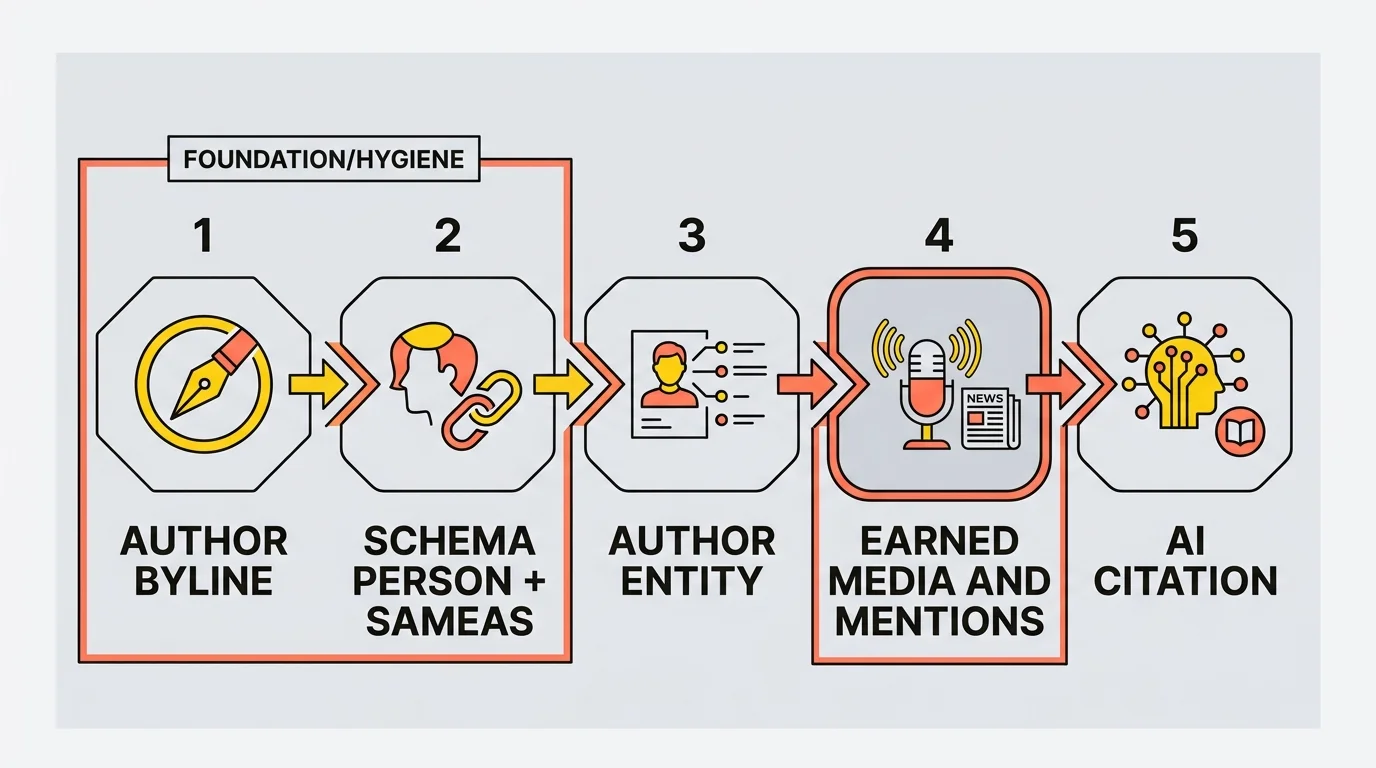
What we do have documented concerns not the author itself but the authority of sources beyond your own site — and here the data is strong. Generative engines cite earned media (third-party sources) above all: roughly 84% of AI citations come from earned media, while paid content accounts for about 0.3% (Muck Rack, May 7, 2026; 25M+ links). The number of independent brand mentions correlates with a brand’s AI visibility roughly three times more strongly than backlinks and Domain Rating: mentions at 0.656–0.709 versus backlinks at 0.218 and DR at 0.266–0.326 (Ahrefs, December 12, 2025; 75,000 brands). And the bias toward earned media is systematic and strong — stronger than in classic Google (Chen et al., September 10, 2025, arXiv preprint 2509.08919).
The authority signal does not live in your schema markup — it lives in what independent sources say about you and your authors. A real, named expert who is cited and mentioned beyond their own site is credible to a model for the same reason they are credible to a human: someone else vouches for them.
So treat the author page and sameAs as the foundation of identity, not a citation trick. Their job is to make the author a recognizable, consistent entity that earned media has someone to cite — not to lift visibility on their own. It is also worth remembering that citing a URL and naming a brand are two different events: 61.7% of AI citations are ghost citations, where the link is present but the brand is never named in the answer text, and only 38.3% of citations include a brand mention (Semrush and Kevin Indig, June 9, 2026; 115 prompts).
Real expert authors or anonymous content?
Choose real expert authors — because only they satisfy Google’s self-assessment questions on authorship (“Who”) and competence (“an expert or enthusiast who demonstrably knows the topic well”) at once, which anonymous content cannot do by definition (Google Search Central, 2025). Anonymous content gives you no byline for a bio to lead to, no entity to mark up in sameAs, and — most importantly — no named person for independent media to cite.
In our view the right order is the reverse of most guides: first build real, named authors with a clear specialization and external profiles, then treat Person schema and sameAs as the technical closure of that identity, not a substitute for it. It is the same shift in approach we break down in GEO vs SEO: what actually changes — in a world of AI-generated answers, source authority and author identity weigh more than technical markup.
If you want to see how your brand and your authors are actually surfaced and cited across generative engines before you decide what to build, that is exactly the scope of an AI visibility audit: see our GEO services.
FAQ
Is E-E-A-T a ranking factor in Google and AI?
No — E-E-A-T is a content quality framework, not a direct ranking factor. The Quality Rater Guidelines are used to evaluate search systems, and rater scores do not feed directly into rankings (Google Search Central, December 15, 2022). In generative features it works indirectly, because they are built on the same core ranking and quality systems as Search (Google Search Central, May 21, 2025).
Will adding Person schema and sameAs increase AI citations?
There is no causal evidence for it. Google strongly recommends marking the author up as a Person with url or sameAs to disambiguate them (Google Search Central, 2025), but in an Ahrefs quasi-experiment, adding schema did not significantly raise AI citations (AI Overviews −4.6% significant; AI Mode +2.4% and ChatGPT +2.2% not significant) (Ahrefs, May 11, 2026). Mark up the author for identity hygiene, not for a promised lift.
Why are real expert authors better than anonymous content for author authority in AI search?
Because only a real author satisfies both of Google’s self-assessment questions: self-evident authorship (“Who”) and the competence of an expert who demonstrably knows the topic (Google Search Central, 2025). A named author also gives independent media someone to cite — and earned media accounts for roughly 84% of AI citations (Muck Rack, May 7, 2026), while brand mentions correlate with AI visibility about three times more strongly than backlinks (Ahrefs, December 12, 2025).