
An entity is a machine-recognizable unit of knowledge about the world — a brand, a person, a product, a place — described by one canonical name and a set of attributes that recur consistently across many sources. In practice, entity SEO means organizing how AI systems understand who your company is: one name, one definition, the same picture of the brand across the whole corpus of text written about it. This guide shows how to build a consistent brand signal as an entity — from Organization schema and sameAs to Wikidata — and how to audit the brand entity consistency that models actually see. For the wider discipline this sits inside, see our guide to GEO (generative engine optimization) — the practice of creating and optimizing content so that it gets cited and used in AI-generated answers.
What is a brand entity, and where does an LLM get its picture of it?
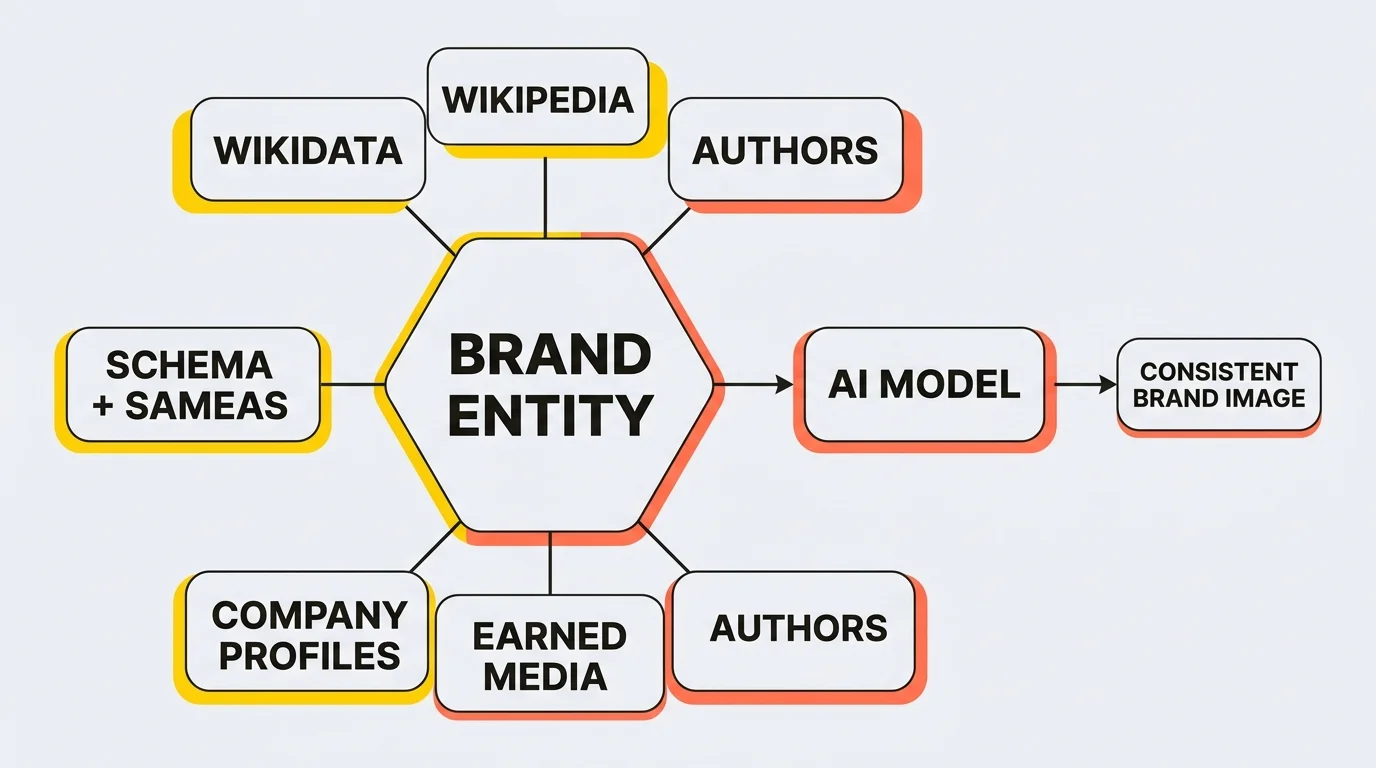
A brand entity is your company seen as a knowledge node — one canonical name linked to facts about what you do, where you operate, and who is behind it — and a large language model (LLM), the text-generating system that powers ChatGPT, Gemini, and Claude, builds its picture of that entity mainly from external sources, not from your own self-description. That is not a guess; it is a pattern visible in citation data. A citation, in an AI answer, is a link or reference to a page as a source within a generative engine — a system that responds with a generated answer instead of a list of links (ChatGPT, Perplexity, Google AI Overviews, Copilot).
The evidence on where engines source brand knowledge points one way:
- Brand queries cite external sources first. Across 23,387 citations for 240 branded queries in 5 engines, citations from earned media outweighed brand-owned content more than two to one — 48% versus 23% (Omniscient Digital, 2026).
- Generative engines feed on earned media. In a set of 25M+ links cited by ChatGPT, Claude, and Gemini across 17 industries, about 84% of citations came from earned media, while paid content accounted for just 0.3% (Muck Rack, 2026).
- Knowledge bases draw from hundreds of sources. Google describes its Knowledge Graph this way: “We draw from hundreds of sources… Wikipedia is a commonly-cited source, but it’s not the only one” (Google, 2020).
The practical conclusion for a brand: you will not build a consistent entity with an “About” page alone. The entity’s picture forms in the external corpus — and it is either consistent there, or the model receives conflicting signals. How engines decide which of those sources to cite is what we unpack in how LLMs choose sources.
Why is brand entity consistency a working hypothesis, not a measured factor?
Because no study isolates entity description consistency as a single variable and measures its effect on AI citations — it is a well-founded “corpus consensus” hypothesis, not a proven ranking factor. To be honest about it: the mechanism (models build the brand picture from external sources) is documented by indirect evidence, but the leap to “therefore a consistent description raises citations” remains untested directly (indirect evidence: Omniscient Digital, 2026). So we treat entity consistency as a low-cost good practice, not a guaranteed lever.
What argues for organizing it anyway, despite the absence of an isolating study:
- Brand mentions correlate with AI visibility more strongly than links. Across 75,000 brands, the count of independent branded web mentions correlated with AI visibility at 0.656–0.709 (Spearman), against 0.218 for backlinks and 0.266–0.326 for Domain Rating — roughly three times stronger (Ahrefs, 2025). If mentions across many sources matter, a consistent description inside those mentions is a cheap way to reinforce the signal.
- Heavily cited content is dense with entities. In a study of 18,012 verified citations from roughly 3 million answers, text frequently cited by ChatGPT had a mean entity density of 20.6% — three to four times above normal English prose (Kevin Indig / Search Engine Land, 2026). Clearly named entities are a trait of the content models like to cite.
A consistent entity is one canonical name and one repeatable brand description across the whole corpus that machines read — not a citation trick, but the removal of contradictions that would otherwise force a model to guess who you are. The cost is low, and the downside is close to zero.
How do Organization schema and sameAs organize entity identity?
Organization schema and the sameAs property are how you tell machines, explicitly, “this is the same organization,” tying scattered profiles and reference pages into a single entity — this is identity hygiene, not a declared ranking lever. Structured data (schema.org) is machine-readable content markup; it does technical hygiene work, not citation-multiplier work. The definition of the sameAs property is unambiguous: “URL of a reference Web page that unambiguously indicates the item’s identity. E.g. the URL of the item’s Wikipedia page, Wikidata entry, or official website” (Schema.org, 2026).
Google’s documentation confirms the mechanism and cools expectations at the same time: sameAs in Organization structured data is the URL of a page with additional information about the organization (a social profile or a review site, for example), and you can list several of them — “You can provide multiple sameAs URLs” — while the document (updated April 15, 2026) declares no ranking benefit from adding them (Google Search Central, 2026). In other words: sameAs is a documented mechanism for resolving entity identity and connecting an organization to the Google Knowledge Graph, but without numeric evidence of impact on LLM citations (Schema.org, 2026).
A sensible set of sameAs targets for a brand includes:
- a Wikidata entry and (if one exists) a Wikipedia article — reference bases for entity identity;
- company profiles: LinkedIn, X, YouTube, GitHub, Crunchbase;
- the brand’s official site as the entity’s canonical address.
What matters just as much is what schema does not solve. Google states plainly that no special schema is needed for AI Overviews or AI Mode: “You don’t need to create new machine readable files… There’s also no special schema.org structured data that you need to add” (Google Search Central, 2025). The only large causal test backs this up: pages cited by AI carry JSON-LD about three times more often (on a sample of 6 million URLs), yet a quasi-experiment (1,885 pages with schema added versus roughly 4,000 controls) found no causal rise in citations — AI Overviews −4.6%, AI Mode +2.4%, and ChatGPT +2.2%, the last two not statistically significant (Ahrefs, 2026). Ship Organization and sameAs as an unambiguous identity signal, not as a promise of citations.
What role do Wikipedia and Wikidata play as entity signals?
Wikipedia and Wikidata are among the best-documented sources from which machines resolve entity identity — strong, but not the only ones. The scale of the graph that consumes them is large: the Google Knowledge Graph held more than 500 billion facts about 5 billion entities per its last official figure (Google, 2020; Google has published no newer statistic). Wikidata itself — a structured, machine-readable knowledge base that feeds, among others, the Knowledge Graph — held 122,333,094 items as of (Wikidata:Statistics, 2026).
That Wikipedia and Wikidata really do feed AI systems is confirmed by the market: through Wikimedia Enterprise, the Wikimedia Foundation struck commercial data-access deals with major AI and tech firms — partners named include Amazon, Google, Meta, Microsoft, Perplexity, and Mistral AI (financial terms undisclosed) (The Batch, 2025). That is a practical reason to get a Wikidata entry in order: it is a reference target for sameAs and data that flows into the corpus of many models.
A caveat on proportion: Wikipedia is a commonly cited source but — in Google’s words — “not the only one” (Google, 2020). No Wikipedia article does not exclude a brand from what models know; a correct, verified Wikidata entry is a more realistic first step than fighting for an encyclopedia page.
How do you run a brand entity consistency audit?
An entity consistency audit is a systematic check of whether your canonical name, description, and key attributes are identical everywhere machines see them — and discrepancies are conflicting signals the model has to resolve by guessing. Start by fixing one canonical name and one defining sentence for the brand, then check consistency source by source:
| Area | What to check | Consistency signal |
|---|---|---|
| Canonical name | Same form everywhere (with/without “Labs,” consistent spelling, no variants) | One name = one entity; variants split the signal |
| Brand description | The same defining sentence on the site, in the footer, About, and external profiles | A repeatable description = corpus consensus |
| Organization schema + sameAs | Valid JSON-LD with a full sameAs set (Wikidata, socials, official URL) | An unambiguous “this is the same organization” |
| Wikidata | Entry exists and is correct, with consistent labels and reference links | A reference target for entity identity |
| External profiles | LinkedIn, directories, media — same name, description, URL | Consistent earned media reinforces the node |
| Authors | Consistent bio, role, and sameAs for the brand’s author-people | Person entities link to the brand entity |
When you interpret the audit, separate two things that are easy to conflate: a citation (a link to a source) and a brand mention (the brand name in the AI answer text, with no link). These are distinct phenomena — across 3,981 domain occurrences, 61.7% of citations were “ghost citations,” links with no brand named in the answer text; the brand was named in only 38.3% (Semrush + Kevin Indig, 2026). A ghost citation is a URL cited as a source without the brand being named in the answer text. A consistent entity helps turn a “ghost” into a named brand — because the model has one repeatable picture it can call up. We break the split down in ghost citations.
We run this same entity consistency audit as part of an AI visibility audit — measuring where and how a brand appears in generative engine answers. If you want to see how consistent (or contradictory) your brand signal is today, start with an AI visibility audit. It is also the natural point of contact with what we describe in GEO vs SEO — what changes: identity fundamentals carry over into the new channel; magic shortcuts do not.
FAQ: entities and brand entity consistency
Do I need a Wikipedia page for AI to know my brand?
No. The knowledge bases that feed models draw from hundreds of sources, and Wikipedia is a “commonly-cited source, but it’s not the only one” (Google, 2020). A more realistic first step is a correct Wikidata entry (122M items as of July 8, 2026 — Wikidata, 2026) plus independent brand mentions, which correlate with AI visibility more strongly than backlinks (Ahrefs, 2025).
Will adding sameAs increase my brand’s AI citations?
There is no numeric evidence for that. sameAs is a documented mechanism for resolving entity identity and connecting it to the Knowledge Graph (Schema.org, 2026), but Google’s documentation declares no ranking benefit from adding it (Google Search Central, 2026), and the only large experiment found no causal rise in citations after adding schema (Ahrefs, 2026). Deploy sameAs as identity hygiene, not as a citation promise.
What matters more for entity consistency — schema or mentions in other sources?
External sources. Google confirms that AI features need no special schema (Google Search Central, 2025), and brand mentions correlate with AI visibility about three times more strongly than backlinks (Ahrefs, 2025). Schema and sameAs are cheap identity hygiene; the weight of the signal is carried by a consistent, repeatable brand description across many independent sources — and that is the “corpus consensus” hypothesis worth organizing for despite the lack of an isolating study (Omniscient Digital, 2026).