What does “perplexity” actually mean?
Perplexity has three meanings you will run into: the everyday word, the machine-learning metric, and the AI company. In plain English, perplexity is a state of confusion. In natural language processing, perplexity is a standard metric of how well a language model predicts text: the lower the perplexity, the less “surprised” the model is by the next word.
The third meaning is the one marketers need to care about. Perplexity is the AI company behind the answer engine of the same name — and the rest of this article covers that product: how it works, how it picks the websites it cites, and what that means for your brand.
What is Perplexity AI and how does it work?
Perplexity is a free AI-powered answer engine that, in the company’s own words, “provides accurate, trusted, and real-time answers to any question” (Perplexity homepage, as of July 2026). Instead of ten blue links, the user gets a synthesized answer with numbered citations pointing to the pages it drew from. That makes Perplexity the textbook example of a generative engine — a system that answers with a generated response instead of a list of links.
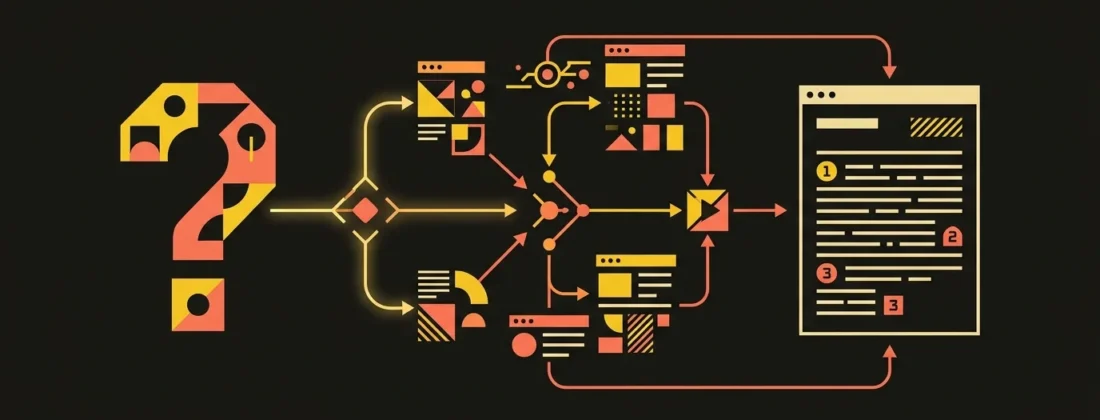
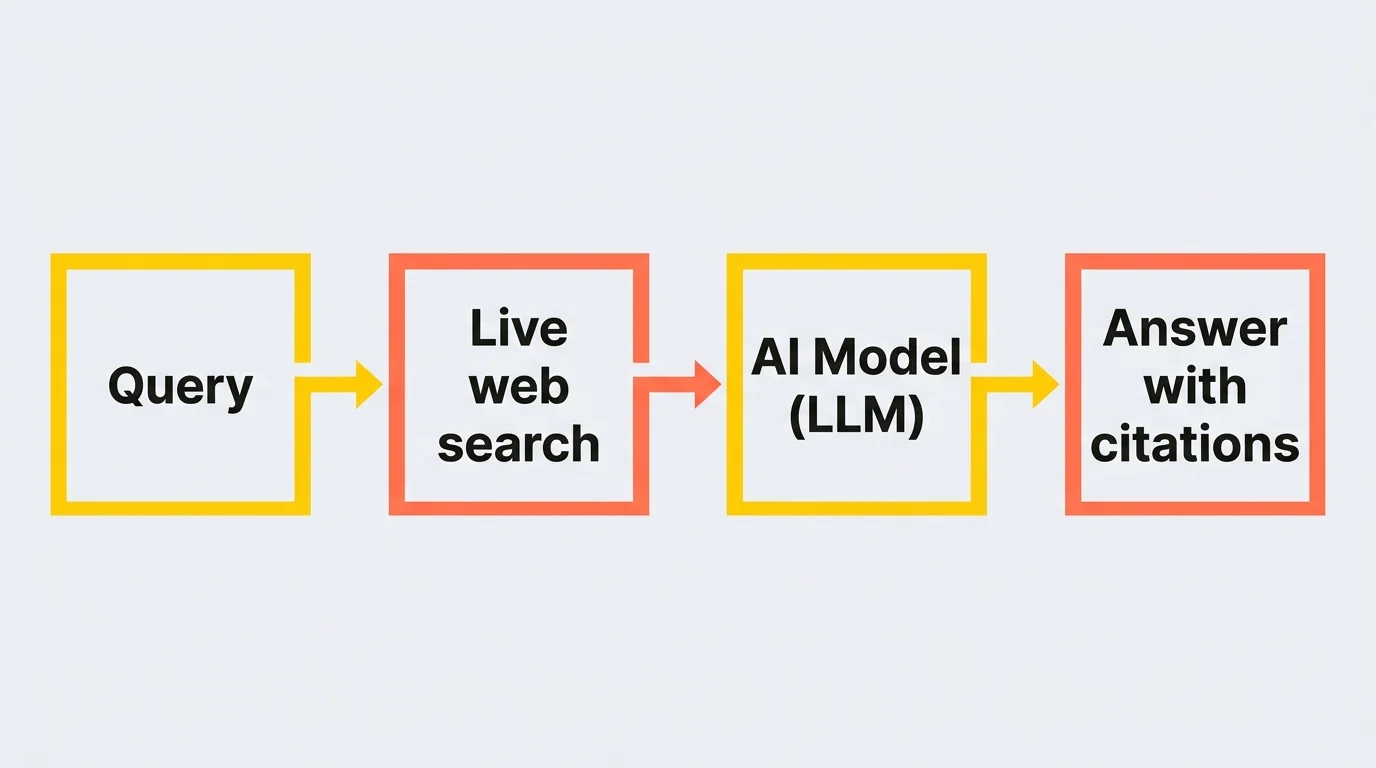
The official documentation spells out the mechanics: Perplexity “combines live web search with multiple leading AI models to give you up-to-date answers, backed by citations you can verify” (Perplexity Hub, Getting started, as of July 2026). In practice, a three-step loop: the system searches the live web, a large language model (LLM) synthesizes an answer from the retrieved pages, and every key sentence gets a numbered footnote to a specific URL. This mechanism — grounding, basing the answer on live search results rather than on training data alone — is Perplexity’s default, not an optional mode.
The scale is no longer niche. Per figures CEO Aravind Srinivas shared at the Bloomberg Tech Summit, Perplexity handled 780 million queries in May 2025 — roughly 30 million per day, growing more than 20% month over month, up from 3,000 queries on its first day in 2022 (TechCrunch, 2025). The takeaway for marketers is blunt: this is a real channel where users ask informational and purchase-intent questions — and where your brand is either cited or invisible.
How is Perplexity different from ChatGPT and Google?
Perplexity differs from ChatGPT in that live search and visible citations are on by default, and from Google in that the generated answer replaces the ranking instead of sitting on top of it. In one view:
| Feature | Google (organic results) | ChatGPT | Perplexity |
|---|---|---|---|
| Core product | ranked links (+ AI Overviews) | conversation with a model | answer with citations |
| Live web access | yes (own index) | optional (search mode) | default, on every query |
| Source citations | none (the link is the result) | only in search mode | always, numbered per sentence |
| What drives brand visibility | ranking position | model knowledge + grounding | being selected as a cited source |
The differences also show up in citation data. An Ahrefs study of 15,000 long-tail queries found that Perplexity sticks closest to Google of all the chatbots: 28.6% of its citations come from Google’s top 10 for the same query — versus 8.6% for Copilot, 8.2% for Gemini, and 8.0% for ChatGPT’s in-text citations; at the same time, around 80% of chatbot citations do not rank anywhere in Google for the original query (Ahrefs, 2025). Strong SEO helps more in Perplexity than in any other engine — but it is not sufficient, because most cited pages come from outside the ranking. We unpack that rule change in GEO vs SEO: what changes.
Perplexity also rewards freshness more than organic Google: the average page it cites is 1,166 days old, versus 1,432 days in organic results; AI assistants overall cite content 25.7% fresher (Ahrefs, 2025, 16.975 million cited URLs). The domain mix differs too: in Profound’s analysis of 680 million citations (August 2024 – June 2025), Perplexity’s most-cited domain was Reddit at 6.6%, while ChatGPT’s number one was Wikipedia at 7.8% (Profound, 2025). Caveat: source patterns vary between engines and shift over time — treat these numbers as a snapshot of that period, not a permanent rule.
What is PerplexityBot, and how do you let it crawl your site?
PerplexityBot is Perplexity’s indexing crawler — per the official documentation, it is “designed to surface and link websites in search results on Perplexity,” is not used to collect content for training AI foundation models, and respects robots.txt (Perplexity Docs, Perplexity crawlers, as of July 2026). If you want to be cited in answers, this bot needs access to your site. The minimal setup:
- Allow the bot in robots.txt: a
User-agent: PerplexityBotsection withAllow: /(or noDisallowrules blocking the content you want cited). - Check server-level and WAF blocks: firewalls, CDNs, and anti-bot rules can cut off AI crawlers regardless of robots.txt.
- Verify by IP, not just user agent: Perplexity publishes the bot’s official IP ranges at perplexity.com/perplexitybot.json (Perplexity Docs, as of July 2026) — the only reliable way to tell the real bot from impersonators.
- Serve content in plain HTML: key information rendered only via JavaScript may be invisible to the crawler.
Perplexity also runs a second fetcher: Perplexity-User visits a page at the moment a user asks a question — and, per the same documentation, it “generally ignores” robots.txt rules because the visit is human-initiated (Perplexity Docs, as of July 2026). Anyone who genuinely wants to block Perplexity needs WAF rules or IP blocks, not robots.txt alone. Know the controversy here, too: Cloudflare documented in August 2025 that Perplexity was using undeclared “stealth” crawlers — rotating IPs and ASNs outside its published ranges, with a user agent impersonating Chrome on macOS — to evade no-crawl directives; Perplexity denied the allegations (Cloudflare, 2025). For brands that want visibility, the practical conclusion stands either way: let the declared bots in and watch your logs.
What does Perplexity mean for your brand’s visibility?
Visibility in Perplexity means being a cited source, not holding a ranking position — a fundamental shift for marketing. A citation in an AI answer is a link or reference to your page as a source within the generated response. Winning those citations is the job of GEO (generative engine optimization) — creating and optimizing content so that it gets cited and used in AI-generated answers. For the full playbook, see our generative engine optimization guide.
Perplexity turns search into a conversation with sources: your brand’s visibility is decided not by where you rank, but by whether the engine judges your page worth citing.
What raises the odds of being cited? The most-invoked evidence is the GEO paper’s experiment (KDD 2024), run in part on the production Perplexity.ai: adding quotations lifted content visibility by roughly 21% on the PAWC metric, adding statistics by roughly 37% on the Subjective Impression metric, while keyword stuffing lowered visibility by roughly 10% (Aggarwal et al., GEO, KDD 2024). One caveat: the independent C-SEO Bench replication (NeurIPS 2025) did not confirm these effects — treat them as a signal, not a guarantee.
The second thing to internalize: 61.7% of citations in AI answers are ghost citations — the page is linked in the sources, but the brand is never named in the answer text; only 38.3% come with a brand mention (Semrush and Kevin Indig, 2026, N=3,981 domain occurrences across ChatGPT, Google AI Overviews, Gemini, and Google AI Mode). The study did not cover Perplexity itself, but the split it measures applies to any engine that cites sources: a cited URL and a brand mention are two different phenomena — and two separate KPIs.
Perplexity is also outgrowing “just search.” On July 9, 2025, it launched Comet, a browser with a built-in AI assistant, initially for subscribers of the $200-per-month Max plan (TechCrunch, 2025). August 2025 brought Comet Plus at $5 per month — a publisher revenue-sharing model paying for three traffic types: human visits, search citations, and AI agent actions (Perplexity, 2025); per press reports, the pool is $42.5 million and publishers keep 80% of subscription revenue (Digiday, 2025). And according to reporting by The Information, Perplexity closed a $200 million round at a $20 billion valuation in September 2025, two months after raising $100 million at $18 billion (TechCrunch, 2025, not officially confirmed).
If you do not know whether Perplexity sees your brand at all, an AI visibility audit measures where and how your domain appears in generative engine answers — Perplexity included.
How do you check whether Perplexity cites your website?
The simplest method is a manual test: ask Perplexity the questions your customers ask and inspect the citations in each answer. To make the measurement reliable rather than anecdotal, use four elements:
- A fixed prompt set — 30 to 50 questions matching your customers’ intents, run monthly with identical wording so results stay comparable.
- Separated KPIs — count citations of your URLs separately from brand mentions in the answer text; per the Semrush study (2026), most citations are ghost citations without a mention.
- Server logs — PerplexityBot (indexing) and Perplexity-User (visits triggered by user questions) confirm the engine is fetching your pages; verify requests against the published IP ranges.
- Referral traffic — filter sessions with a perplexity.ai referrer in your analytics; direct proof that citations convert into clicks.
If the audit shows competitors getting cited while you are not, the gap is usually in the content — missing unambiguous facts, dates, and sources — rather than in the technology. Fixing that is where the work described in the GEO guide begins.
FAQ: common questions about Perplexity
Is Perplexity AI free?
Yes — Perplexity defines itself as a free AI-powered answer engine (Perplexity, as of July 2026). Paid tiers exist too: the top Max plan cost $200 per month and was the first to include the Comet browser after its July 9, 2025 launch (TechCrunch, 2025). The free version is enough to check whether Perplexity cites your site.
Does blocking Perplexity in robots.txt work?
Only partially. The indexing crawler PerplexityBot respects robots.txt per the official documentation, but the Perplexity-User fetcher, acting on a user’s request, “generally ignores” those rules (Perplexity Docs, as of July 2026). An effective block requires WAF rules or IP blocks on the published ranges. From a brand-visibility standpoint, though, blocking is usually a self-inflicted wound.
Does Perplexity use Google’s search results?
Perplexity has its own index and crawler, but its citations overlap with Google more than any other chatbot’s: 28.6% of its cited sources come from Google’s top 10 for the query — versus 8.0–8.6% for ChatGPT, Gemini, and Copilot (Ahrefs, 2025, 15,000 queries). Ranking well in Google raises your odds of a citation, but roughly 70% of Perplexity’s citations come from outside that top 10.